
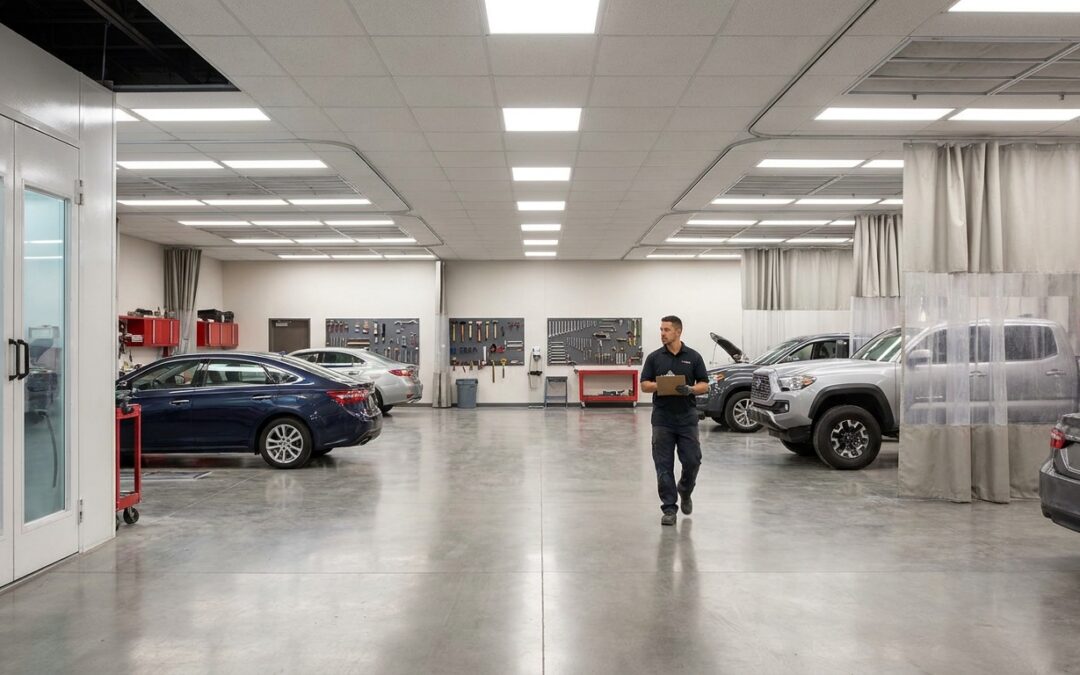
How to Pick the Best Body Shop in Gilbert, AZ: A Buyer’s Guide for 2026
Most articles on “best body shops” are just a list of shops with star ratings. This isn’t one of those. The best body shop for you depends on what you’re actually trying to fix, what your vehicle is, and what trade-offs you’re willing to accept. A shop that’s perfect for a quick bumper scuff might be wrong for a structural rebuild — and a shop with great Google reviews might be subletting half its work to a third party you’ve never heard of. This guide is a real buyer’s checklist: the criteria, the red flags, and the questions to ask before you hand someone your keys in Gilbert, Mesa, Chandler, Tempe, or Queen Creek.
Network Collision Repair is a family-owned body shop on Gilbert Road. We’ve been doing collision repair in the East Valley for 30 years — and we’ve seen the inside of just about every other shop in this market through cars that came to us for second opinions and post-repair inspections. This guide reflects what we’ve learned about what separates real shops from shops that just look good in advertising.
Want a Free Estimate to Compare Against Other Shops?
Send us photos of the damage or bring the vehicle in. We’ll give you a written estimate you can use as a benchmark against any other quote you get. Free, no pressure.
The Real Criteria That Separate Good Body Shops From the Rest
Forget star ratings for a minute. Star ratings tell you whether customers were happy at delivery. They don’t tell you whether the repair was done correctly under the paint — which is what really matters 6 months and 6 years later. Here’s what to actually look at.
1. In-House Capabilities vs. Sublet Work
Most East Valley body shops do not own a frame measuring system, a downdraft paint booth, ADAS calibration equipment, or all the tools needed for modern repair. When they don’t, they sublet the work to a third party — which means longer turn times, less oversight, and a final result only as good as a shop the original picked, not the shop you picked.
Ask: “Do you have a frame measuring system on-site? Do you paint in-house? Do you do ADAS recalibration in-house?” If the answer is “we have a guy who does that” for any of them, factor that into your decision.
2. Paint Quality and Color Match
Color match in modern automotive paint is not eyeballing a paint code. It’s using a digital spectrophotometer that reads your specific aged paint and computes a custom mix that accounts for how your car has faded in the Arizona sun. A 2018 white Toyota and a 2024 white Toyota are not the same white anymore. The gun has to know that.
Ask: “Do you color match with a spectrophotometer? What paint brand do you use?” You want to hear PPG, Axalta, Sikkens, or BASF — not an unspecified import. More on what separates real paint shops here.
3. OEM Repair Procedures and Certifications
Automakers publish specific repair procedures for every modern vehicle. Aluminum panels need rivet bonding, not welding. Some structural sections require squeeze-type resistance spot welding. Adhesives have to be applied in specific locations and quantities. Skipping these procedures compromises crash performance.
Ask: “Are your technicians I-CAR trained? Do you follow OEM repair procedures? Are you certified for [your vehicle’s manufacturer]?”
4. Warranty
Quality shops offer a lifetime workmanship warranty on body and paint work for as long as you own the vehicle. Less than lifetime is a tell.
Ask: “What’s your written workmanship warranty?” Get it in writing.
5. Independence From Insurance
Direct Repair Program (DRP) shops have agreements with insurance carriers to deliver repairs at negotiated pricing and turn times. Many DRP shops do excellent work. Some don’t — the financial pressure to hit insurer targets can encourage cut corners on parts, labor times, and procedures.
A non-DRP or selectively-DRP shop is free to write supplements for everything actually needed to fix your car correctly, rather than what the insurer’s software template assumes.
Ask: “Are you on the insurer’s direct repair program? Will you write supplements as needed?” More on the insurance side here.
6. Transparency
Good shops will show you the booth. Show you the frame rack. Walk you through their process. Send photos during repair. Provide line-itemed estimates. Explain what’s OEM vs. aftermarket.
If a shop is defensive about showing their work, that’s your answer.
7. Experience and Stability
How long has the shop been in business under the same ownership? Long-tenured shops have reputations they protect and craftsmanship that comes from doing this for decades. Brand-new shops can be great too — but you’re paying for the learning curve.
8. Reviews — But Read Them
Look for shops with 100+ reviews and a 4.5+ average. Then actually read the recent ones. Look for specific stories rather than “great service.” Look at how the shop responds to negative reviews — that tells you everything about how they’ll handle a problem with your car.
Red Flags: What Should Make You Walk Away
- Quoting major work over the phone without seeing the car
- Refusing to show you the booth, frame rack, or shop floor
- Cash-only or refusing to put the estimate in writing
- No mention of paint brand or specifying off-brand paint
- Mask-everything paint approach for a panel replacement (no disassembly)
- No frame measuring system on-site for a vehicle with structural damage
- No written warranty or warranty under lifetime workmanship
- Pressure to use their preferred insurer or steering you away from your own insurance
- Aggressive defensiveness when asked about ADAS calibration, OEM parts, or paint matching
- “We’ll figure it out” instead of a clear written scope of work
- Quotes dramatically lower than competitors for the same scope — the math means something is being skipped
Already Have a Quote That Feels Off?
Bring it to us. We’ll write you an honest second-opinion estimate so you can compare line items side by side. Free.
Match the Shop to the Job
Different repairs need different shop capabilities. Here’s the rough match guide:
| What You Need | What the Shop Must Have |
|---|---|
| Bumper scuff repair | Quality paint booth, spectrophotometer color match |
| Door ding / hail / minor PDR | Skilled PDR technician (often a specialist) |
| Panel replacement (collision) | Full collision shop with paint booth, OEM parts sourcing, I-CAR training |
| Structural / frame work | Frame measuring system on-site, certified welders, OEM weld procedures, ADAS recalibration |
| Full repaint or color change | Climate-controlled downdraft booth, full disassembly capability, premium urethane systems |
| Restoration / classic / show paint | Specialized shop with restoration experience, multi-stage paint capability, block-sanding craftsmanship |
| Post-repair inspection or DV claim documentation | Independent shop with measuring equipment and paint depth gauges, willing to inspect another shop’s work |
The 10-Question Buyer’s Checklist
Print This and Take It With You
- Do you have a frame measuring system on-site?
- Do you paint in-house in a climate-controlled downdraft booth?
- What paint brand and clear coat do you use?
- Do you color match with a spectrophotometer?
- Do you do ADAS recalibration in-house?
- Are your technicians I-CAR trained or OEM-certified for my vehicle?
- What’s your written workmanship warranty?
- Will you provide a line-itemed written estimate?
- Can I see your booth, frame rack, and shop floor before I commit?
- Will you talk to my insurance adjuster directly and write supplements as needed?
A shop that answers all 10 confidently and shows you around without hesitation is a shop you can trust. A shop that hedges, gets defensive, or rushes you through the questions is telling you something important.
↓ Want Network Collision’s Answers to All 10 Questions?
Send us a quick note — we’ll send you our written answers to all 10 questions plus a free estimate for whatever repair you’re considering. No obligation.
What About “Insurance Preferred” Shops?
When you file a claim, your insurer will steer you toward Direct Repair Program (DRP) shops. These shops are not necessarily bad — many are excellent. But the relationship creates structural pressure: the shop has agreed to negotiated labor times, parts pricing, and turn times. When real repair scope exceeds the insurer’s template, a DRP shop has to choose between fighting the insurer (risking their DRP status) and cutting corners.
Your alternative: pick a quality independent shop that is willing to write supplements and advocate for the correct scope of repair. In Arizona, you have the right to choose your shop under ARS §20-469 regardless of what your insurance company prefers.
What About Online Reviews?
Useful but read carefully. Tips:
- Look at review count plus recency. 200 reviews from 5 years ago means less than 80 reviews in the last 12 months.
- Read the 3-star reviews — they’re usually more honest than 5-star or 1-star reviews.
- Look at how the shop responds to complaints. Defensive responses tell you everything.
- Look for specific stories rather than “great experience.” Vague praise is usually less reliable than specific narratives.
- Check multiple platforms — Google, Yelp, BBB, Facebook. Patterns matter more than any one rating.
What About Price?
Price matters — but the cheapest quote is almost never the best deal. The math is brutal: if Shop A quotes $1,500 and Shop B quotes $2,500 for what looks like the same job, the $1,000 difference is going somewhere. Usually it’s coming out of paint quality, prep depth, parts grade (aftermarket vs. OEM), or skipped operations like ADAS calibration.
The goal isn’t the lowest price — it’s the right price for the right scope. Get itemized quotes and compare line by line. When line items differ between quotes, ask why.
Network Collision’s Answers to the 10 Questions
Since we wrote them, we should answer them publicly.
- Frame measuring system on-site? Yes. Electronic measuring with OEM-spec tolerances.
- Paint in-house in a downdraft booth? Yes. Climate-controlled.
- Paint brand and clear coat? PPG and Axalta. UV-stable urethane two-stage.
- Spectrophotometer color match? Yes. On every refinish job.
- ADAS recalibration in-house? Yes.
- I-CAR training and OEM certifications? Yes. 30 years of continuous training and certifications.
- Written workmanship warranty? Lifetime, in writing.
- Line-itemed written estimates? Always.
- Open shop tours? Anytime during business hours, no appointment needed.
- Will we talk to your adjuster and write supplements? Yes. We do it every day.
You don’t have to take our word for it — come look. Read our reviews. Get an estimate. Use this checklist on us and any other shop you’re considering, and pick whoever stands up to the questions.
Best Body Shop FAQ — Gilbert, AZ
What’s the most important thing to look for in a body shop?
In-house capabilities. Shops that own a frame measuring system, paint booth, and ADAS calibration tools control the entire repair quality. Shops that sublet major work depend on someone else’s craftsmanship and timeline.
Are insurance preferred shops better?
Not necessarily. They have a financial relationship with insurers that can create pressure to cut scope. Many DRP shops are excellent; many are not. You have the right under Arizona law (ARS 20-469) to choose any shop you want, regardless of which shop your insurer prefers.
How do I know if a shop is really following OEM procedures?
Ask. Reputable shops will explain how they follow OEM repair procedures, what certifications their technicians hold, and what tools they use for OEM-specific repairs (rivet bonding, squeeze-type resistance spot welding, etc.). An honest shop will admit when they need to source a procedure or train on a new technique.
Should I get multiple estimates?
Yes — especially for repairs over $1,500. Compare line items, not just total prices. Differences between estimates point to differences in scope or quality.
What if my insurance won’t pay enough for the shop I want?
Quality shops negotiate scope and write supplements directly with insurers. You don’t have to handle the back-and-forth yourself. Pick the shop you want and let them work with your adjuster. More on this here.
Are cheaper body shops always worse?
Not always — but the cheapest quote on the same scope is almost always cutting something. The math doesn’t work otherwise. Get itemized estimates and ask why specific line items differ between quotes.
What if I’ve already had work done and I’m worried about quality?
Get a post-repair inspection from an independent shop. A written report documents what was done correctly and what wasn’t, and gives you leverage if you need to demand a re-repair from the original shop.
Do you serve Mesa, Chandler, Tempe, and Queen Creek?
Yes. Network Collision Repair is at 1021 N Gilbert Rd Unit 105, Gilbert, AZ 85234 and serves the entire East Valley.
Pick the Right Shop. Pay Once.
If you’re shopping body shops in Gilbert or anywhere in the East Valley, take this checklist with you. Ask the questions. Look at the booth. Read the warranties. The shop that stands up to scrutiny is the shop that’ll stand by your repair years from now.
Or call us directly at (480) 691-2299 · 1021 N Gilbert Rd Unit 105, Gilbert, AZ 85234
Related reading: Auto Body Shop Gilbert AZ · Auto Paint Shop · Insurance Claim Help · Post-Repair Inspection · What to Do After an Accident · All Services