
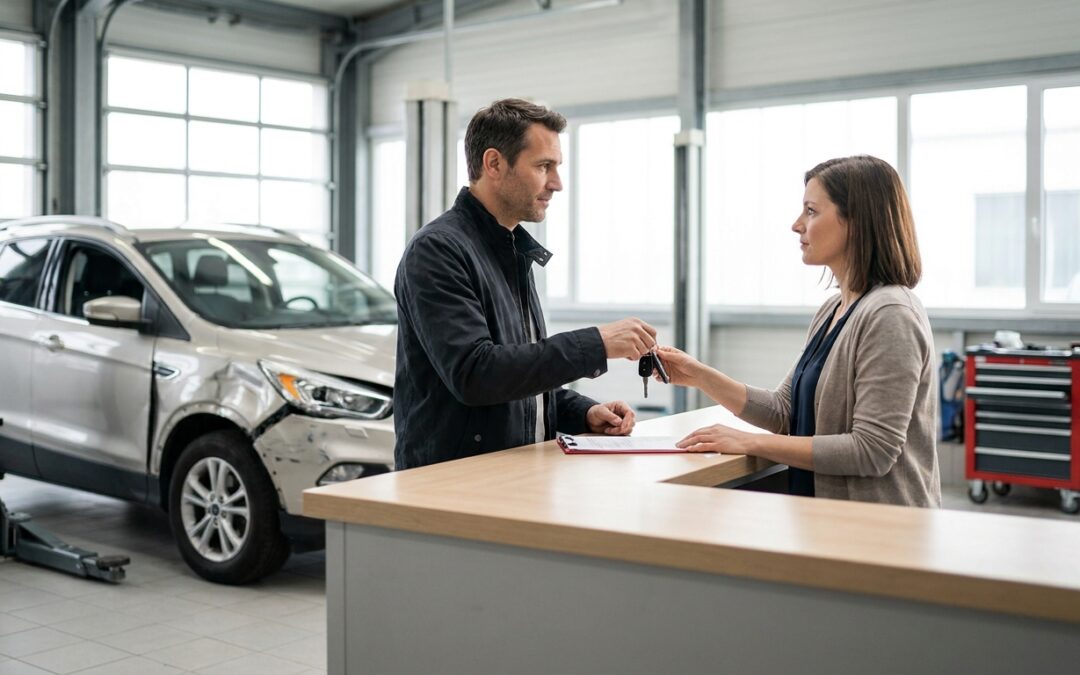
Insurance Claim Help Gilbert AZ: An East Valley Driver’s Guide to Filing a Collision Claim Without Getting Shortchanged
Getting into a collision is stressful enough. Then the insurance claim starts — and suddenly you’re being pushed toward a “preferred” shop you’ve never heard of, told your car is a “total loss” for what sounds like a low number, and asked to sign paperwork you don’t fully understand. If you’ve searched Insurance Claim Help Gilbert AZ in the last week, you’re not alone, and you’re not being paranoid. There are real decisions in the claims process that can cost you thousands of dollars, affect the resale value of your vehicle, and even impact your safety — and most Arizona drivers only go through this once or twice in a lifetime.
At Network Collision Repair in Gilbert, we’ve been walking East Valley drivers through the insurance claim process since 1995 as part of the Network Automotive family. This guide lays out exactly what to do after a crash in Gilbert, Mesa, Chandler, Queen Creek, or Tempe — what your rights are under Arizona law, how to choose a body shop (hint: you don’t have to use your insurer’s pick), what to watch for in your estimate, and when it’s worth escalating. We’ll also cover the difference between your insurance and the at-fault driver’s insurance, how diminished value claims work in Arizona, and the supplement process that recovers hidden damage.
The First 24 Hours After a Collision: Your Claim Checklist
What you do — and don’t do — in the first day after a crash will shape the entire claim. Arizona is an at-fault state, which means the driver who caused the accident (and their insurance) is financially responsible for damage. But proving fault, documenting damage, and protecting your rights starts at the scene.
- Safety first, then document. Move to a safe shoulder if vehicles are drivable. Turn on hazards. Check on everyone involved and call 911 if anyone is hurt.
- Call Gilbert PD (or local jurisdiction). Any collision with injury, disabled vehicles, or more than minor damage should be reported. Arizona law (ARS §28-667) requires reports for crashes with injury, death, or property damage over $2,000.
- Photograph everything. All four sides of every vehicle, wide shots showing the roadway and positions, damage close-ups, license plates, insurance cards, the other driver’s license, road conditions, skid marks, signage, and any surrounding context.
- Exchange info, not opinions. Get name, phone, insurance carrier, policy number, plate, driver’s license number, and VIN. Do not admit fault, apologize in a way that could be read as admission, or speculate about causes.
- Get witness contact info. Independent witnesses are gold in disputed-fault cases. Ask for name and phone before they leave.
- File your claim — with your own carrier first. Even if the other driver was at fault, open a claim with your insurance so they can coordinate. You’ll decide later whether to go through your collision coverage or the other driver’s liability.
- Do NOT agree to a body shop yet. The claims adjuster will almost always recommend a “preferred” shop on the first call. Just say you’re evaluating options and will provide a shop name shortly.
Your Right to Choose Your Own Body Shop in Arizona
This is the most misunderstood part of the entire claims process, and it costs Arizona drivers more money than any other single factor. When you call in a claim, the insurance adjuster will almost always steer you toward a “Direct Repair Program” (DRP) shop — sometimes gently (“we can set you up quickly with one of our preferred providers”), sometimes aggressively (“we can’t guarantee the repair if you use a non-network shop”). Both statements misrepresent your rights.
Why insurers push their preferred shops
DRP shops agree to specific labor rates, parts sourcing (often aftermarket or used), and cycle times in exchange for a steady stream of referrals from the insurer. That’s not automatically bad — some DRP shops do excellent work. But the shop’s incentive structure is aligned with the insurer, not with you. Lower parts cost, faster cycle times, and tighter labor allowances all benefit the carrier’s loss ratio. They don’t always benefit the quality of your repair.
Why an independent shop like Network Collision works differently
- We write the estimate your vehicle actually needs — including OEM parts when the manufacturer’s procedures require them.
- We handle the insurance negotiation on your behalf, including supplements when hidden damage is discovered during disassembly.
- We don’t have a volume contract with any carrier, so we’re not rushing your job to hit a cycle-time quota.
- We follow I-CAR and OEM repair procedures — some DRP shops cut corners to stay within insurer labor allowances.
- Your lifetime workmanship warranty comes from us, not the insurer. DRP warranties often evaporate if the shop drops out of the network.
What to actually say when the adjuster pushes a preferred shop
Simple, polite, firm: “Thanks for the recommendation. I’m having the vehicle taken to Network Collision Repair in Gilbert. Please direct the appraisal and all correspondence there.” That’s it. No argument, no explanation required.
Just Had a Crash? We’ll Handle the Whole Insurance Claim for You.
Filing Through Your Insurance vs. the At-Fault Driver’s Insurance
After a not-at-fault collision in Arizona, you have two paths to repair the damage. Each has tradeoffs, and the right answer depends on your situation.
| Path | Pros | Cons |
|---|---|---|
| Your collision coverage (then subrogation) | Fastest — your carrier starts work immediately. They pursue the at-fault insurer for reimbursement in the background and refund your deductible when successful. | You pay your deductible up front (refunded later if subrogation wins). Small possibility of rate impact, though Arizona not-at-fault claims rarely affect rates. |
| At-fault driver’s liability coverage (third-party claim) | No deductible out of pocket. No involvement from your own insurer. | Slower — their adjuster has to accept liability first. If they dispute fault, repair can be delayed weeks. You may need a rental car out of pocket until settled. |
Which should you choose?
- Go through your own insurance if fault is disputed, the other driver is uninsured/underinsured, you need the vehicle back quickly, or the other carrier is dragging their feet.
- Go through the at-fault driver’s insurance if fault is clear and accepted, you don’t want to pay a deductible up front, and you don’t urgently need the vehicle.
- Always document everything either way. If the at-fault driver’s carrier later disputes fault, you can switch to your own coverage.
What Actually Goes Into a Proper Collision Estimate
The insurance estimate is where most of the real money is lost. Insurance appraisers work fast, often remotely, and frequently miss structural, mechanical, and internal damage. Here’s what a thorough Gilbert collision shop looks at — and what an insurer’s initial estimate usually misses.
Visible damage (what the appraiser writes up)
- Outer panel damage — bumpers, fenders, doors, hood
- Paint and clearcoat damage
- Broken lights, grilles, trim
- Obvious wheel/tire damage
Hidden damage (what proper disassembly reveals)
- Frame rail and unibody misalignment — requires a laser measurement system to detect
- Suspension damage — bent control arms, struts, tie rods, sway bar end links
- Airbag system faults — sensor damage, sensor placement issues, SRS module faults
- ADAS sensor misalignment — forward-collision camera, radar modules, blind-spot sensors
- Cooling system damage — radiator core support, condenser, intercooler
- Wiring harness damage concealed behind panels
- Inner structural brackets, crush zones, and reinforcement bars
- Subframe and cradle damage
- Damaged seals, weatherstripping, and sound-deadening materials that cause future leaks and rattles
Repair procedure requirements (per OEM)
Every major automaker publishes required repair procedures for collision work. A proper estimate incorporates these — many DRP estimates do not. Examples of required items that commonly get missed on first estimates:
- Scan tool pre-scan and post-scan (now required by virtually every OEM)
- ADAS calibration for any sensor that was removed, replaced, or had its mounting surface disturbed
- Seatbelt replacement after airbag deployment
- Specific corrosion-protection procedures for bare metal areas
- Specific weld procedures for structural repairs
- Required OEM parts for structural components (many OEMs now prohibit aftermarket structural parts)
Supplements: Why Your First Estimate Is Almost Never Final
A supplement is an additional line item added to the insurance estimate after disassembly reveals damage that wasn’t visible in the initial walkaround. On a moderate collision, there are almost always supplements — often 30–60% of the original estimate. Most drivers have never heard of them, and insurance companies don’t go out of their way to explain them.
How the supplement process works
- Tear-down / disassembly. We remove damaged panels, bumpers, and covers to inspect underlying structure, suspension, wiring, and mechanical components.
- Documentation. Each item of hidden damage is photographed, described, and priced with parts and labor.
- Supplement submission. We submit the supplement request with supporting photos and OEM procedure references to your insurer.
- Adjuster re-inspection. Sometimes the insurer sends a re-inspector; often it’s approved on paper with good documentation.
- Approval and repair. Once approved, the supplement is added to your total, and repair proceeds with the correct scope.
What to watch for
- A shop that tells you “we’ll just work with what the insurance approved” — that’s code for skipping supplement work and cutting corners.
- An insurer that flat-out denies supplements without a re-inspection — escalate with photos and OEM documentation.
- A shop that buries supplements in the total without explaining them to you — you should see every line item.
Total Loss: What It Means and What to Do
If your repair estimate exceeds a certain percentage of your vehicle’s Actual Cash Value (ACV), the insurer will declare the vehicle a total loss. In Arizona, the threshold is typically 70–80% (varies by carrier). You have rights here too — and most drivers accept the first settlement offer without realizing they can negotiate.
How ACV is calculated
Insurance companies use third-party valuation tools (CCC, Mitchell, Audatex) that pull comparable-vehicle data from recent sales. The valuation report is the starting point, not the final word. You should always:
- Request the full valuation report, not just the number. Review each comparable used.
- Add value for recent maintenance (new tires, new brakes, recent timing belt, etc.).
- Add value for options and packages that weren’t captured in the base comp.
- Dispute comparables that are not truly comparable — different trim, higher miles, different region, salvage title, etc.
- Pull your own comps from AutoTrader, Cars.com, and CarGurus for similar year/make/model/miles in the Phoenix metro — not national averages.
You don’t have to accept the total-loss declaration
If the insurer totals your vehicle but you want to keep and repair it, you can often do so by accepting the ACV minus salvage value. We can help you evaluate whether that math actually works — sometimes it does, sometimes it doesn’t.
Diminished Value Claims in Arizona
Here’s a benefit most East Valley drivers don’t know exists. In Arizona, if you were not at fault in a collision, you can file a diminished value claim against the at-fault driver’s insurance for the loss in your vehicle’s market value caused by having an accident on its history — even after a perfect repair.
Why diminished value matters
A 2023 Honda Accord with a clean history is worth more than the same 2023 Accord with a Carfax entry showing a collision — even if the repair was factory-perfect. That difference is real, and it’s recoverable.
How to pursue a diminished value claim
- Confirm you were not at fault. Diminished value claims only work against the at-fault driver’s insurance.
- Get a professional diminished value appraisal. Independent appraisers in the Phoenix metro typically charge $200–$400 and produce a defensible report.
- Submit the claim to the at-fault insurer with the appraisal and supporting documentation.
- Negotiate. Initial offers are almost always low. Be prepared to counter with market data.
- Small claims court is an option if the insurer won’t negotiate reasonably — Arizona small-claims threshold is $3,500.
Not Sure What Your Claim Should Actually Cover? Let’s Walk Through It.
Rental Cars, Loss of Use, and Loaner Vehicles
While your vehicle is being repaired, you need transportation. Here’s how it actually works across the different coverage scenarios.
| Scenario | Who Pays for Rental | Limit |
|---|---|---|
| Your collision coverage with rental reimbursement | Your insurer | Per your policy (often $30–$50/day, 30-day cap) |
| At-fault driver’s liability (third-party) | Their insurer | Reasonable rental for duration of repair — no preset cap |
| You have no rental coverage and are at fault | You | N/A — out of pocket |
| Total loss | Typically covered until settlement is offered | Varies by carrier, often 3–7 days after offer |
Two tips that save Gilbert drivers money: (1) if you’re going through the at-fault driver’s carrier, they are obligated to cover a comparable-class rental — don’t let them stick you in an economy car if you drive a midsize SUV. (2) If your repair takes longer than expected, most carriers will extend the rental with documentation from the shop showing the reason for the delay.
The 5 Most Expensive Mistakes Gilbert Drivers Make on Insurance Claims
- Signing a release too early. Some adjusters push a “release of all claims” along with the settlement check. Signing it means no supplements, no diminished value, no future claim for related injury. Never sign a release until all work is complete and all claims are resolved.
- Accepting the first total-loss offer. Initial ACV offers are often 5–15% below defensible fair market value. Always request the full valuation report, pull your own comps, and negotiate.
- Agreeing to the insurer’s preferred shop without asking questions. DRP shops can be fine — but not all of them follow OEM procedures, and you are giving up leverage. Arizona law says you choose your shop.
- Skipping the pre-scan / post-scan. Modern vehicles require a full diagnostic scan before and after repair. Some shops and adjusters treat this as optional — it is not, per virtually every OEM.
- Not documenting the claim in writing. Phone conversations with adjusters should always be followed by an email summarizing what was discussed. Create a paper trail from day one.
What Network Collision Repair Does on Every Insurance Claim
When you bring us a claim, we don’t just wait for the insurer’s estimate and work within it. We write our own estimate to OEM standards and negotiate from there. Here’s the specific sequence we follow on every insurance repair in Gilbert:
- Initial inspection and pre-scan. We perform a full diagnostic scan before any disassembly to document all pre-existing faults.
- Photographic documentation. Every angle, every panel, every VIN plate — a full photo record for the claim file.
- OEM procedure lookup. We pull the manufacturer’s published repair procedures for your specific year/make/model and build the estimate to those standards.
- Estimate written to factory spec. Not to the insurer’s labor-allowance target — to what your vehicle actually needs.
- Insurance negotiation. We handle adjuster communication, supplement requests, and escalation on your behalf.
- Teardown and supplement. On disassembly we document and submit supplements for hidden damage.
- Repair to OEM spec. I-CAR certified technicians, OEM parts when required, factory-spec welds and corrosion protection.
- Post-scan, calibration, and QC. Post-repair diagnostic scan, ADAS calibration as required, road test, water test, final alignment check.
- Documented handover. You leave with printed scans, calibration reports, parts receipts, and our lifetime workmanship warranty.
Serving Gilbert, Mesa, Chandler, Queen Creek, and Tempe
Our shop at 1021 N Gilbert Rd, Unit 105, Gilbert, AZ 85234 handles insurance claims for drivers across the East Valley. We’re set up to work directly with every major carrier — State Farm, GEICO, Progressive, Allstate, USAA, Farmers, Liberty Mutual, Nationwide, American Family, Auto-Owners, Travelers, and more — and we handle the paperwork so you don’t have to.
- Gilbert — Power Ranch, Val Vista Lakes, Morrison Ranch, Seville, Agritopia, Heritage District
- Mesa — Eastmark, Las Sendas, Red Mountain Ranch, Dobson Ranch, downtown Mesa
- Chandler — Ocotillo, Sun Lakes, Fulton Ranch, downtown Chandler
- Queen Creek — San Tan Heights, Meridian, Encanterra
- Tempe — ASU area, Lakes, Warner Ranch
- Apache Junction, Gold Canyon by appointment
Same-day towing available if your vehicle isn’t drivable — we coordinate with the insurer directly. See our full list of services or learn more about our shop.
Just Had an Accident? We’ll Handle the Whole Claim.
From the first adjuster call through final delivery — we document, estimate, negotiate supplements, and repair to OEM spec. You focus on your life; we focus on the claim.
Start My Claim FreeTypical Timeline: Claim to Keys Back
Here’s what you can realistically expect for an insurance-covered collision repair in Gilbert:
- Day 1: Accident, police report, call to insurer, vehicle towed or driven to shop
- Day 1–3: Insurer assigns appraiser; shop performs pre-scan and initial estimate
- Day 3–5: Parts ordered; rental car arranged
- Day 5–10: Disassembly, supplement submission, supplement approval
- Day 10–18: Structural and body repair, paint, reassembly
- Day 18–22: Post-scan, ADAS calibration, QC, final alignment
- Day 20–25: Delivery to customer with documentation
Light to moderate collisions wrap faster; severe damage, back-ordered parts, luxury vehicles, and complex supplement negotiations extend the timeline.
Questions to Ask Any Gilbert Body Shop Before You Commit
Before You Drop Off Your Vehicle
- Will you write the estimate to OEM procedures, or to the insurance labor allowance?
- Do you perform pre-scans and post-scans in-house, and will I receive copies?
- Do you calibrate ADAS in-house, or do you sublet it?
- How do you handle supplements? How many supplements do you typically submit per claim?
- Will you use OEM parts when the manufacturer requires them for my vehicle?
- Do you warranty your work for as long as I own the vehicle?
- Are you I-CAR certified?
- Can you provide references from recent insurance claims you’ve handled?
At Network Collision Repair in Gilbert, the answers are: Yes, Yes (copies provided), Yes (in-house with factory-grade tools), Multiple when needed (average 3.4 per claim), Yes when OEM specifies, Yes (lifetime workmanship warranty), Yes (I-CAR certified), Yes.
Why East Valley Drivers Trust Us With Their Claims
We’re part of the Network Automotive family, in business across Arizona since 1995. Our Gilbert collision center was designed for modern vehicles — ADAS, EVs, aluminum-body trucks, luxury cars, HUD-equipped vehicles — and we’re staffed to handle insurance claims start-to-finish without adding to our customers’ stress.
- Family-owned since 1995 — not a corporate chain
- I-CAR certified technicians on every job
- All major insurance carriers accepted — direct billing, no out-of-pocket surprises
- In-house ADAS calibration with factory tools and targets
- Full supplement handling — we fight for the scope your vehicle actually needs
- Lifetime workmanship warranty on every repair
- One-stop collision center — towing, paint, glass, mechanical, detail all under one roof
- Honest pricing — our tagline is “Serve our customers honestly, efficiently, and economically,” and we mean it
Frequently Asked Questions
Do I have to use the body shop my insurance recommends?
No. Under Arizona law (ARS §20-469), insurance companies cannot require you to use a specific repair facility. You have the absolute right to choose any licensed collision shop, including Network Collision Repair in Gilbert, and your insurer must pay that shop per the terms of your policy. The “preferred” or “direct repair” shops recommended by adjusters have volume agreements with the insurer — that’s a benefit to the carrier, not necessarily to you.
Will my insurance rates go up if I file a claim after a not-at-fault accident?
In most cases, no. Arizona carriers typically do not raise premiums for not-at-fault collision claims, and it is unlawful for insurers to non-renew solely on the basis of a single not-at-fault claim. Always confirm with your specific carrier, but a documented not-at-fault loss rarely affects rates. At-fault claims are different and usually do affect premium at renewal.
What is a supplement and why do I need one?
A supplement is an additional line item added to the insurance estimate after disassembly reveals damage that wasn’t visible on the initial walkaround — suspension, frame, ADAS sensors, wiring, and internal structure are common supplement items. The average moderate collision generates 3–4 supplements. A good body shop documents and negotiates supplements on your behalf; a shop that skips them is cutting corners on the repair.
What is diminished value and can I recover it in Arizona?
Diminished value is the loss in market value your vehicle experiences because it now has a collision on its history, even after a perfect repair. In Arizona, if you were not at fault, you can file a diminished value claim against the at-fault driver’s insurance carrier. The statute of limitations is three years. An independent appraisal typically costs $200–$400 and produces a defensible number.
How long does an insurance collision repair take in Gilbert?
Light to moderate collisions run 10–18 business days. Moderate to severe collisions with supplements and ADAS calibration run 18–25 business days. Severe damage, back-ordered parts, and luxury vehicles can extend the timeline further. Most rental reimbursement policies cover 30 days, and insurers will extend with documentation if the shop identifies delays outside its control.
Should I file through my insurance or the at-fault driver’s insurance?
If fault is clear and accepted, going through the at-fault driver’s liability means no deductible out of pocket but can take longer. If fault is disputed, you need the vehicle fast, or the other carrier delays, filing through your own collision coverage is faster — your insurer then pursues subrogation and refunds your deductible if successful. We can help you evaluate which path makes sense for your specific claim.
What happens if my vehicle is declared a total loss?
The insurer pays the Actual Cash Value (ACV) of your vehicle before the accident, plus applicable sales tax, title, and registration fees under Arizona law. Always request the full valuation report and review each comparable vehicle used. Initial offers are often 5–15% below defensible market value — pull your own comps from AutoTrader and Cars.com in the Phoenix metro and negotiate. You can also choose to keep the vehicle and accept the ACV minus salvage value.
Do you handle the insurance paperwork, or do I?
We handle it. We coordinate with the adjuster, submit estimates and supplements, provide photographic documentation, negotiate on your behalf, and resolve any disputes over scope or pricing. You receive status updates and copies of all documents, but you don’t have to manage the claim yourself. Most of our Gilbert, Mesa, and Chandler customers tell us the claims-handling is the biggest difference between us and other shops.
Had an Accident? We’ll Take It From Here.
Free claim reviews, direct billing with every major carrier, and OEM-spec repairs backed by a lifetime workmanship warranty. Family-owned in Gilbert since 1995.
Related reading: What to Do After an Accident · Diminished Value Claims · Post-Repair Inspection · Collision Repair Mesa AZ · Best Body Shops in Gilbert