
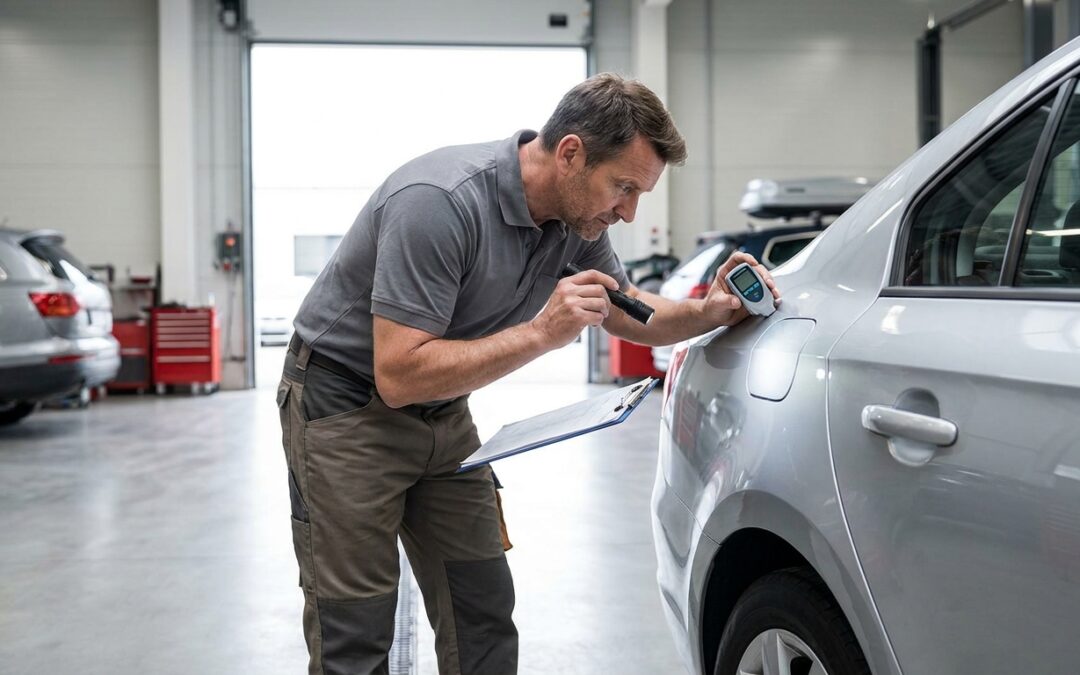
Post-Repair Inspection in Gilbert, AZ: How to Find Out If Your Body Shop Actually Fixed Your Car Right
Your car looks great when you pick it up from the body shop. Shiny paint, panel gaps that look right, doors that close. But that’s exactly the problem — most post-collision repair failures aren’t visible to the naked eye. Used or aftermarket parts substituted in without your approval. Frame measurements that are 8mm off spec. ADAS sensors never recalibrated. Paint that’s 2 mils thinner than factory. A post-repair inspection is how you find out before it costs you $20,000 at trade-in or, worse, the airbags don’t fire correctly in the next accident. This guide walks through what a real post-repair inspection is, what it costs in Gilbert, and how Network Collision Repair has been doing them in the East Valley for 30 years.
Network Collision Repair is a family-owned auto body shop on Gilbert Road. We do collision repairs as our primary business — and we also do post-repair inspections on cars that were repaired at other shops, because too many of those cars come back with problems the original shop hid. If you just got your vehicle back from a repair and something feels off, or you’re about to buy a used car and want to know if the body work was honest, this is the article for you.
Schedule a Post-Repair Inspection
Independent, written, photographed. We inspect every panel, measure paint thickness, check frame geometry, and verify ADAS calibration. Same-day reports in most cases.
What a Post-Repair Inspection Actually Is
A post-repair inspection (PRI) is an independent, written audit of collision repair work performed by a shop that did not do the original repair. The inspecting shop has no financial interest in defending the work — just in documenting what is and isn’t correct, with photos and measurements.
A real PRI covers four categories of potential problems:
- Structural / safety integrity — frame measurements, unibody pulls, weld quality, restraint system function, ADAS calibration
- Parts substitution — whether OEM parts were used as billed, or whether used / aftermarket / counterfeit parts were swapped in
- Cosmetic / refinish quality — paint match, film thickness, orange peel, blend lines, panel alignment, gaps
- Documentation / billing accuracy — was every line item on the estimate actually performed
The deliverable is a written report (usually 8–20 pages with photos) that you can use to demand the original shop redo the work, to support a diminished value claim, to push back on an insurance settlement, or to walk away from a used-car purchase.
When You Should Get a Post-Repair Inspection
Not every repair needs an independent audit. But for any of these situations, the inspection cost almost always pays for itself.
1. After a Moderate-to-Severe Collision Repair
Any repair involving structural work (frame pulls, unibody damage, replaced rails, replaced quarter panels) deserves a PRI. The risk-to-cost ratio is obvious: a $200–$400 inspection vs. tens of thousands in hidden damage and safety risk.
2. After an Insurance “Preferred” Shop Did the Work
Insurance companies steer customers to direct repair program (DRP) shops where the insurer has negotiated pricing and turn-times. Many DRP shops do excellent work. Some don’t — the financial pressure to hit insurer targets can encourage cut corners on parts substitution and labor times. A PRI on a DRP repair is cheap insurance.
3. Before Filing a Diminished Value Claim
A formal PRI report dramatically strengthens a DV claim because it documents real (not theoretical) repair-related diminished value — the additional loss caused by imperfect repair work that compounds inherent DV. Pairs perfectly with the steps in our Arizona diminished value claim guide.
4. Before Buying a Used Car With a Carfax Accident
That “clean title” SUV with one accident on Carfax might be a great deal, or it might be hiding $8,000 in shortcut repairs. A pre-purchase PRI is the only way to know.
5. If Something Feels Wrong After Repair
Pulling to one side. Vibration above 50 mph. Wind noise that wasn’t there before. Doors that don’t close right. Paint that looks different in sunlight than it did under shop lights. These are all real symptoms that warrant an inspection.
6. Lease Return / Pre-Sale
A documented PRI in your file protects you against accusations of hidden damage and can be the difference between a clean lease return and a $2,500 charge.
Used Car Pre-Purchase Inspection
Buying a used vehicle in the East Valley? Bring it to us for a 60-minute body-and-structure inspection before you sign. Same-day written report.
What a Real Post-Repair Inspection Includes
This is the inspection we run at Network Collision. Some shops cut steps to advertise a cheaper inspection — ask exactly what’s included before you book anywhere.
Step 1: Estimate & Documentation Review
We read the original repair estimate, supplements, and final invoice line-by-line and cross-reference what was billed against what we can verify on the vehicle.
Step 2: Visual Inspection — Inside and Out
Every panel under 3M Sun Gun and overhead swirl lighting. Door jambs, trunk gutters, fuel door, hood underside, engine bay edges. We’re looking for: paint texture mismatch, overspray, paint runs, panel-edge dust, body filler shrinkage, and missing inner-structure paint.
Step 3: Paint Depth Gauge on Every Panel
Factory paint film thickness is typically 4–7 mils. Refinished panels are often 7–12 mils. Repaired-and-refinished panels with body filler underneath can read 15–30 mils. We map paint thickness on every panel and flag inconsistencies.
Step 4: Panel Gap and Alignment Measurements
Doors, hood, trunk, fenders, bumpers all checked against OEM specs. Off-spec gaps point to body-line misalignment, often from a structural pull that wasn’t straightened back to factory.
Step 5: Structural Measurement (When Applicable)
For repairs involving frame or unibody work, we put the vehicle on our laser/electronic measuring system and compare against OEM datum points. Tolerances are typically ±3mm. Out-of-spec measurements are documented with the OEM number, the actual number, and the variance.
Step 6: Parts Verification
We pull part numbers off replaced panels (when visible) and compare against what was billed. OEM, OEM-equivalent, aftermarket, and used parts each have distinct identifying marks. We document what’s actually on the vehicle vs. what was paid for.
Step 7: ADAS Calibration Verification
Forward-collision camera, blind-spot radar, lane-keep, adaptive cruise — if these systems were on the vehicle, they almost certainly needed calibration after the repair. We pull the scan history and verify calibration completion. Missed ADAS calibration is the #1 hidden defect we find in PRIs.
Step 8: Test Drive
30–60 mph on smooth pavement to check for pull, wander, vibration, and wind noise. ADAS function check (does adaptive cruise actually track lanes properly).
Step 9: Written Report
Photos of every finding, paint thickness map, parts verification table, structural measurement printout, and a plain-English summary of what was done right, what wasn’t, and what we’d recommend. Delivered same day or next morning.
What a Post-Repair Inspection Costs in Gilbert, AZ
| Inspection Type | Typical 2026 Cost | Time |
|---|---|---|
| Basic visual + paint thickness | $125 – $200 | 30–45 min |
| Standard PRI (visual + paint + ADAS scan) | $200 – $325 | 60–90 min |
| Comprehensive PRI w/ structural measurement | $350 – $550 | 2–3 hrs |
| Pre-purchase used-car body inspection | $150 – $275 | 45–60 min |
| Forensic inspection for litigation | $650 – $1,500+ | 4–8 hrs |
Free for Network Collision repair customers. If we did the original repair, the post-repair inspection is included in our lifetime workmanship warranty — bring it back any time and we’ll re-inspect at no charge.
The Five Most Common Defects We Find
1. Missed ADAS Calibration
By far the most common. Forward-facing cameras and radar must be calibrated any time the bumper or windshield is replaced, and any time alignment or ride height changes. Most shops know this; many quietly skip it because calibration adds time and requires special equipment they don’t own. The result: your car’s automatic emergency braking might fire 6 feet later than it should. Real safety issue.
2. Aftermarket Parts Billed as OEM
The invoice says “new OEM bumper cover.” The bumper on the car is actually a Taiwan-import aftermarket part that doesn’t fit quite right and uses different mounting points. You paid for OEM, you got aftermarket. PRI finds this by pulling part numbers and casting marks.
3. Body Filler in Place of Panel Replacement
The estimate said “replace fender.” Paint depth gauge shows 18 mils on the front edge of the fender, with body filler signature underneath. The fender wasn’t replaced — it was bondo’d and resprayed. Major fraud, expensive to correct.
4. Structural Measurements Out of Tolerance
The car drives OK but the front rails are 4–8mm off OEM spec. Suspension geometry is fighting itself, tires will wear unevenly, and in the next collision the energy management won’t fold the way it was designed to. Documented on our measuring system.
5. Refinish Defects (Paint Match, Texture, Film Build)
Halo around a blended panel that’s visible in sunlight. Orange peel that doesn’t match adjacent panels. Insufficient clear coat film build that will fade in 2–3 Arizona summers. Almost always cosmetic, but often the difference between a $1,500 trade-in deduction and full retail value.
↓ Free Initial Phone Consultation
Not sure if you need a full inspection? Call us, tell us what happened, and we’ll honestly tell you whether a PRI makes sense for your situation — or if your symptoms are normal post-repair behavior. No charge for the conversation.
What Happens After the Inspection
You have the written report. Here are the most common next steps.
If the Original Repair Was Acceptable
Great. You have documented proof that the work was done correctly, which protects your trade-in / lease return value and quiets any concerns. File the report with your service records.
If Minor Cosmetic Defects Were Found
Take the report back to the original shop. Reputable shops will fix workmanship defects under warranty without argument. We can also fix the issues here if you prefer not to return to the original shop.
If Major Defects Were Found
You have leverage. Options:
- Demand a re-repair from the original shop under their warranty.
- Demand reimbursement for the cost of correct repair to be performed elsewhere.
- Reopen the insurance claim with the inspection report as evidence.
- File a complaint with the Arizona Department of Insurance or Better Business Bureau.
- Pursue legal remedies — the inspection report is a foundational piece of evidence in litigation.
If You’re Filing a Diminished Value Claim
The PRI report gives your DV demand letter real teeth — especially if it documents repair-related diminished value on top of inherent. See our Arizona DV claim guide for the rest of the playbook.
Why Network Collision Is the Right Shop for an Independent PRI
- 30 years repairing collision damage. We know what right looks like because we do it every day.
- Frame measuring system on-site. Real structural measurement, not eyeball estimates.
- Paint depth gauges, swirl-inspection lighting, ADAS scan tools. Same equipment we use for our own work.
- We’re not financially attached to any insurer. Independent reports, written honestly, regardless of which carrier paid the bill.
- Same-day or next-morning reports in most cases.
- Family-owned, East Valley local. Read about us on the About page.
What to Bring to Your Inspection Appointment
- The vehicle (obviously)
- Original repair estimate and supplements
- Final repair invoice
- Photos of the damage before repair, if you have them
- Carfax / AutoCheck report if available
- The other shop’s contact info (occasionally we’ll call them directly to clarify what was done)
- Any specific concerns or symptoms you’ve noticed
Post-Repair Inspection FAQ — Gilbert, AZ
How much does a post-repair inspection cost in Gilbert AZ?
Visual + paint-thickness inspections run $125–$200. Standard PRI with ADAS scan and written report: $200–$325. Comprehensive inspection including structural measurement: $350–$550. Forensic inspections for litigation: $650 and up. Free for Network Collision repair customers under our lifetime workmanship warranty.
How long does an inspection take?
Basic visual: 30–45 minutes. Standard PRI: 60–90 minutes. Comprehensive with structural measurement: 2–3 hours. We can usually deliver the written report the same day or by next morning.
Do I need to leave the car?
For standard inspections, no — usually wait-while-you-watch. For comprehensive inspections involving structural measurement and a test drive, we may keep the vehicle for half a day.
Can a post-repair inspection help with an insurance dispute?
Yes. A written inspection report from an independent shop is exactly the type of documentation insurers, regulators, and courts take seriously. It is the foundational evidence for reopening a claim or escalating to the Arizona Department of Insurance.
Will the original shop be upset that I’m getting a second opinion?
Reputable shops welcome second opinions because they have nothing to hide and they want satisfied customers. Shops that get defensive about independent inspections are usually the ones you most need to inspect.
Can you inspect a used car I’m thinking about buying?
Yes. Pre-purchase body inspections are one of the highest-value services we offer for used-car buyers. We can identify hidden collision history, undisclosed paint work, structural defects, and parts substitution — saving you from buying a problem.
Do you inspect work done by any shop, or only some?
Any shop. We don’t care who did the original repair — our job is to honestly document what’s on the vehicle today.
Do you serve Mesa, Chandler, Tempe, and Queen Creek?
Yes. Network Collision Repair is at 1021 N Gilbert Rd Unit 105, Gilbert, AZ 85234. Post-repair inspection clients drive in from across the East Valley.
Find Out What Your Shop Didn’t Tell You
Whether you just picked up your car from another shop, you’re shopping a used vehicle with accident history, or you’re filing a diminished value claim, an independent post-repair inspection is the most valuable few hundred dollars you’ll spend on the car.
Or call us directly at (480) 691-2299 · 1021 N Gilbert Rd Unit 105, Gilbert, AZ 85234
Related reading: Diminished Value Claim Arizona · Insurance Claim Help · Rear End Collision Repair · Auto Body Shop · All Services