
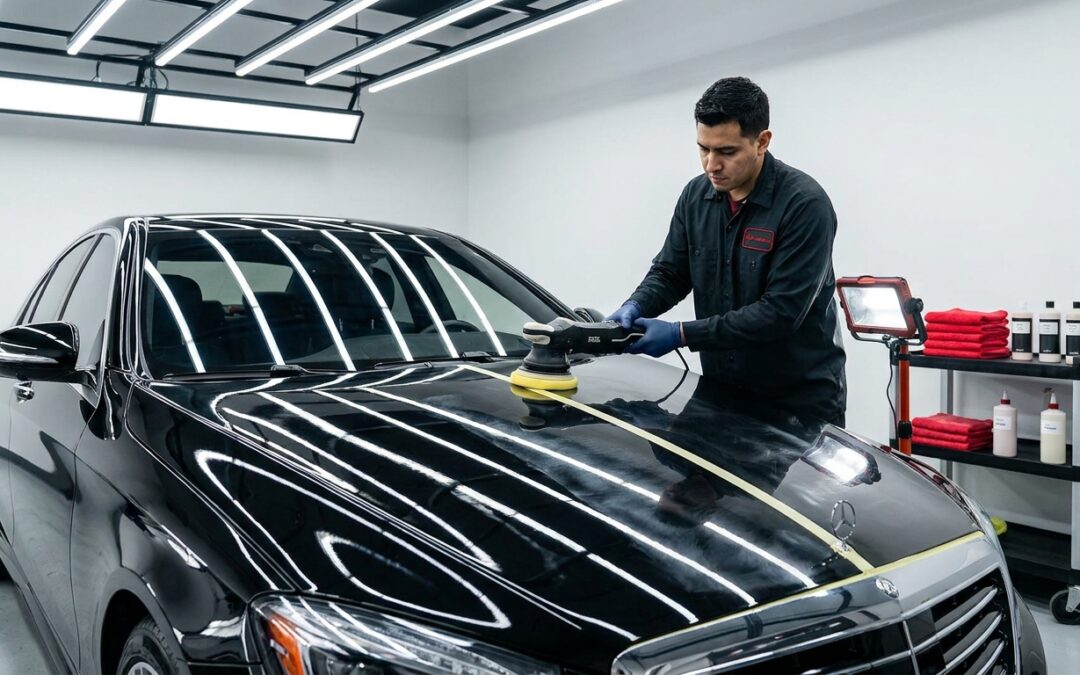
Paint Correction in Gilbert, AZ: The Honest Guide to Swirls, Scratches, and Making Your Paint Look Better Than New
Arizona sun is brutal on paint. Between the UV, the dust storms, the automatic car washes, and the pollen every March, most vehicles in Gilbert are carrying thousands of tiny scratches, swirl marks, and oxidation that make the paint look dull, hazy, and a shade lighter than it should be. Paint correction is how you fix it — not a wax, not a quick detail, but a multi-stage polishing process that actually removes the damage and brings the color back. This guide walks through exactly what paint correction is, how it’s done right, what it costs in Gilbert, and how to know if your car needs a one-step, a two-step, or a full concours-level correction.
At Network Collision Repair, we’ve spent 30 years repairing and refinishing paint on everything from daily drivers to restoration projects here in the East Valley. Paint correction sits at the intersection of detailing and body shop craft — it’s the same skill set our painters use to blend a fresh repair into an older panel, applied to your entire vehicle. If you’ve been driving around Gilbert, Mesa, Chandler, or Queen Creek wondering why your black car looks gray, your red car looks pink, or every panel has a cobweb of swirl marks under the sun — this is the article for you.
Get a Free Paint Correction Quote
Tell us your vehicle and what’s bothering you. We’ll give you an honest assessment — sometimes a one-step polish is all you need.
What Paint Correction Actually Is
Paint correction is the process of mechanically removing a microscopic layer of clear coat to level out surface defects — swirl marks, fine scratches, water spots, oxidation, bird-etching, holograms, and buffer trails left by amateur work. It’s done with a dual-action or rotary polisher, graded abrasive compounds, and different foam, microfiber, or wool pads depending on how severe the damage is. When done correctly, it restores clarity and depth to the paint so colors look richer and reflections look sharp — not hazy.
Here’s what it’s not: it’s not a wax, not a ceramic coating, not a “hand polish” you can buy at the auto parts store. Those products fill in or mask defects temporarily. Real paint correction physically removes them. The results are permanent until new damage occurs.
The Three Levels of Paint Correction
Not every car needs a $2,000 concours detail. In fact most don’t. A good shop will assess your paint under proper lighting and recommend the minimum level of correction required to hit the finish you’re paying for. Here’s how we break it down at Network Collision.
One-Step Correction (Enhancement Polish)
A single pass with a medium-cut compound and polishing pad. Removes roughly 60–70% of light swirl marks and minor imperfections. Best for newer cars (under 3 years old), lease returns, and vehicles that just need a refresh before applying a ceramic coating. Takes 4–6 hours on a mid-size sedan.
Two-Step Correction
A cutting stage with a more aggressive compound to level deeper defects, followed by a polishing stage to refine the finish and remove haze left by the compound. Removes 85–95% of swirls, most light scratches, and heavier oxidation. This is the sweet spot for most daily drivers in Arizona — especially darker colors that show every imperfection. Takes 10–16 hours depending on size and condition.
Multi-Stage / Show-Car Correction
Three or more stages, often including wet-sanding specific panels to remove deep scratches, orange peel, or bird-dropping etching. Reserved for show cars, high-end exotics, full restorations, or clients who want a mirror finish that wouldn’t be out of place at Barrett-Jackson. Can take 25–50+ hours.
| Level | Defect Removal | Time | Best For |
|---|---|---|---|
| One-Step | 60–70% | 4–6 hrs | Newer cars, pre-coating prep, lease refresh |
| Two-Step | 85–95% | 10–16 hrs | Daily drivers, dark paint, moderate swirls |
| Multi-Stage | 95–99% | 25–50+ hrs | Show cars, exotics, restorations |
How Network Collision Does Paint Correction
Our process is dialed in because it’s the same care we take blending fresh paint into an existing panel on a collision repair. Every step matters.
Step 1: Inspection Under Real Lighting
We inspect every panel under a combination of overhead LED swirl-inspection lighting and handheld 3M Sun Gun lighting. This is non-negotiable. The fluorescent lights in most garages hide 80% of swirl marks — we use lights that reveal them so we know exactly what we’re correcting. We measure clear coat thickness with a paint depth gauge on every panel so we never remove more than is safe.
Step 2: Thorough Decontamination Wash
Two-bucket hand wash with pH-neutral soap, followed by an iron-fallout remover to dissolve brake dust and industrial fallout bonded to the paint, followed by a clay bar or clay mitt to pull embedded contaminants out of the clear coat. Skipping this step means you’re grinding dirt into the paint on the first pass — creating new scratches while trying to remove old ones. Every paint correction job at Network Collision starts here.
Step 3: Test Spot
We pick a representative panel — usually the hood or trunk lid — and run a test section with the exact compound and pad combo we plan to use on the whole car. We inspect it, measure depth removal, and adjust aggression up or down before committing. This is how you avoid burning through clear coat on a door edge 20 hours into a job.
Step 4: Correction Passes
Depending on the level you chose, we run one, two, or multiple stages panel by panel. Between each stage we wipe every panel with a dedicated panel-prep solution to strip the compound oils and reveal the true finish so nothing is hiding.
Step 5: Final Inspection + Protection
Full re-inspection under swirl lighting. Any remaining defects get spot-corrected. Then we recommend protection — because a correction without protection is only going to last until the next automatic car wash. Options: a quality sealant (6–8 months), a spray-on SiO2 coating (1–2 years), or a proper professional ceramic coating (3–7+ years depending on the product).
Not Sure What Level You Need?
Send us a couple of well-lit photos of your paint and tell us your year/make/model. We’ll tell you honestly whether you need a one-step, a two-step, or something in between.
What Paint Correction Costs in Gilbert, AZ (2026 Prices)
Paint correction pricing is about time, skill, and consumables — not magic. Here’s what honest 2026 pricing looks like in the East Valley from a shop that actually does the work rather than hiding defects under a glaze.
Typical Ranges by Vehicle Size
- Compact / sedan, one-step: $400–$650
- Compact / sedan, two-step: $850–$1,350
- SUV / crossover, one-step: $550–$800
- SUV / crossover, two-step: $1,100–$1,700
- Full-size truck / large SUV, two-step: $1,400–$2,000
- Multi-stage / show-level correction: $1,800–$4,500+
Add-ons that commonly land on top of those numbers: headlight restoration ($100–$180), wheel-face polish ($150–$300), engine-bay detail ($120–$200), and ceramic coating application ($600–$2,200 depending on product and prep). Ceramic makes sense on top of a correction — correcting paint and then not protecting it is leaving money on the ground.
Signs Your Car Actually Needs Paint Correction
Some signs are obvious. Others sneak up on you because the damage accumulates slowly. Any of these mean it’s time for a correction assessment:
- Cobweb swirls visible under direct sunlight — especially on darker paint colors (black, dark gray, navy, maroon)
- Color looks faded or chalky compared to how you remember it — that’s oxidation from Arizona sun
- Water spots that won’t wash off — mineral-etched water spots require polishing to remove
- Reflections look blurry rather than sharp — clear coat should act like a mirror; if it looks like bathroom-fogged glass, it’s filled with micro-marring
- Holograms or buffer trails from a previous amateur polish job
- Bird-dropping or bug etching that didn’t come off with regular washing
- Preparing for a ceramic coating — you should always correct before coating, because coatings seal in whatever is underneath
- Selling or turning in a lease — corrected paint shows massively better in photos and in-person
↓ Free Paint Assessment
Not sure if your swirls are light enough for a one-step or bad enough to need a two-step? Send us photos — we’ll tell you what we see and give you an honest quote, including whether you’d be better off not doing anything at all.
Why Arizona Is Especially Hard on Paint
We’re not making this up to sell more corrections. Gilbert sits in one of the most punishing paint environments in the country.
UV Radiation
Phoenix averages 299 sunny days per year and UV-index readings of 11+ through the summer. UV breaks down the clear coat resin molecules over time, causing it to go cloudy, yellow, and eventually crack and peel. Correction removes the oxidized top layer and exposes healthy clear coat beneath — but only a coating or consistent sealant protects against it happening again.
Dust, Haboobs, and Monsoon Season
A single haboob dumps measurable abrasive silica onto every horizontal panel in the East Valley. Then people wipe it off with a dry towel — that’s the #1 cause of swirl marks we see in the shop. Always rinse before wiping.
Automatic Car Washes
The rotating cloth and foam tunnels on most Gilbert automatic car washes run 24/7 — the same cloths that touched a dusty landscaping truck at 7am will touch your car at 7:05am. This is why automatic car washes are the single fastest way to swirl-mark a vehicle. Touchless car washes are better, but the high-pressure chemicals are still harder on sealants and coatings than a proper hand wash.
Water Quality
East Valley tap water has a total dissolved solids reading of 450–650 ppm — high enough that letting your car air-dry in the sun after a wash will permanently etch water spots into your clear coat. Always dry immediately with a clean plush microfiber, or invest in a simple deionized water rinse.
Paint Correction vs. Ceramic Coating vs. Wax: What’s the Difference?
These terms get used interchangeably in marketing, but they solve different problems.
| Product/Service | What It Does | Lasts | Fixes Swirls? |
|---|---|---|---|
| Wax | Adds a thin sacrificial gloss layer; hides minor marring | 6–12 weeks | No — masks only |
| Sealant | Synthetic polymer protection layer; harder than wax | 4–8 months | No |
| Ceramic Coating | SiO2 chemical bond to clear coat; strong hydrophobic + UV protection | 2–7 years | No — locks in whatever is underneath |
| Paint Correction | Physically removes clear-coat defects | Permanent (until new damage) | Yes |
The right stack for most Gilbert drivers: correction first, then coating. Coating without correction is like sealing a dirty window — you’re just locking the problem in.
Why Choose Network Collision Repair for Paint Work
There are plenty of mobile detailers and tunnel car washes offering “paint correction” in the East Valley. Some are fantastic. Many aren’t. Here’s why people who know paint choose Network Collision.
- 30 years of paint experience under one roof. Our painters blend clear coats for a living — polishing is the same science with different pad choices.
- Paint depth gauge on every panel. We measure before, during, and after. We won’t burn through your clear coat.
- Climate-controlled shop. Temperature affects how compound breaks down. We work in the low 70s year-round. Mobile work in an Arizona driveway in July does not produce the same result.
- Honest assessments. If a one-step is all you need, we’ll tell you. If your paint is too thin for correction at all, we’ll tell you that too.
- We can fix what a correction can’t. Some defects are too deep for safe polishing — those go through our paint booth for a spot-blend or panel refinish. Not many detail shops can offer both.
- Family-owned, local, reviewed. Read our story on the About page and see the reviews from your neighbors in Gilbert, Mesa, and Chandler.
Paint Correction Timeline: What Your Appointment Looks Like
Most two-step corrections at Network Collision go like this:
- Drop-off / morning inspection — we walk the car with you under our lights, show you the defects, and confirm the plan in writing.
- Decontamination wash — 60–90 minutes.
- Test spot + adjustment — 30 minutes.
- Cutting stage — 4–8 hours panel-by-panel depending on size.
- Polishing / refinement stage — 3–6 hours.
- Final inspection + panel prep wipedown — 1 hour.
- Optional coating application — 2–4 hours, then 12–24 hours cure time in the shop.
For most customers we keep the vehicle overnight or for 2 business days if a coating is involved. We’ll work around your schedule — plenty of our Gilbert and East Valley clients drop off Friday evening and pick up Monday.
Paint Correction FAQ — Gilbert, AZ
How long does paint correction last?
The correction itself is permanent — you physically removed the defects, they can’t come back. What changes is how quickly new defects appear, and that depends entirely on how you wash and protect the car afterward. A corrected-and-coated car washed properly can look freshly corrected for 2–4 years. A corrected-and-run-through-a-tunnel-wash car will look swirled again in 6 months.
Will paint correction remove deep scratches?
If you can catch the scratch with your fingernail, it’s into the base coat and correction won’t fully remove it — we can minimize the appearance, but a permanent fix requires touch-up paint or a spot refinish. If your fingernail slides over it, correction will almost always fully remove it.
Can you polish a car that’s had previous bodywork?
Yes — we just need to know where the repaint is so we can adjust aggression. Fresh paint (under 90 days) should not be heavily polished because the clear coat is still gassing out. After 90 days it polishes the same as factory paint.
Is ceramic coating worth it after a correction?
For most daily-driven Arizona vehicles, yes. The correction cost is the bigger expense — adding a coating is a fraction of that and protects the investment. If you’re planning to sell or trade the car within 12 months, a high-grade sealant is more economical.
Can you do paint correction on a wrapped car?
No — vinyl wraps need specialized cleaning and can’t be polished. If the wrap is damaged we can remove it and correct the paint underneath, or refer you to a wrap installer.
Do you offer paint correction for matte paint?
Matte and satin finishes cannot be polished the way gloss paint can — polishing them creates shiny spots. We clean and protect matte finishes with dedicated matte-safe products rather than correcting them.
How far in advance should I book?
Typically 1–2 weeks for a two-step correction — we keep correction bookings limited so we don’t rush jobs. Call us at (480) 691-2299 to grab a slot.
Do you serve Mesa, Chandler, Tempe, and Queen Creek?
Yes. Our shop at 1021 N Gilbert Rd Unit 105, Gilbert, AZ 85234 serves the entire East Valley. Most clients drive in from Mesa, Chandler, Tempe, Queen Creek, Apache Junction, and South Phoenix.
Bring Your Paint Back to Life
Whether your daily driver has a cobweb of swirls or you want your showpiece looking concours-ready, we’ll give you an honest assessment and a clear plan. No upsells, no mystery pricing.
Or call us directly at (480) 691-2299 · 1021 N Gilbert Rd Unit 105, Gilbert, AZ 85234
Related reading: Auto Body Shop Gilbert AZ · Paintless Dent Repair · Bumper Repair · All Services