
What to Do After a Car Accident in Gilbert, AZ: A Step-by-Step 2026 Guide
Your hands are shaking, your phone is buzzing, and someone’s walking toward your car. Take a breath. You’re going to be okay, and you’re going to handle this correctly — because this guide tells you exactly what to do in the next 30 minutes, the next 24 hours, and the next 30 days. From the first photo at the scene to the moment you pick your repaired vehicle up, here’s how to protect yourself, your car, your insurance rate, and your wallet after a car accident in Gilbert or anywhere in the East Valley.
Network Collision Repair is a family-owned auto body shop on Gilbert Road that has been repairing vehicles in the East Valley for 30 years. We’ve walked thousands of customers through the after-accident process — from minor fender benders to total losses. This guide is the same playbook we’d give a family member who just got into an accident. Bookmark it. Forward it. Save it to your phone so you have it when you need it.
Already in the Middle of It?
If you’ve just been in an accident in Gilbert and need help right now — estimates, claim guidance, a repair plan — call us or send us photos. We’ll walk you through the next steps.
The First 5 Minutes: Stay Calm and Safe
Immediate Steps
- Check for injuries. You first, then passengers, then the other vehicle’s occupants. If anyone is injured, call 911 immediately.
- Move to safety if you can. If the vehicles are drivable and traffic is dangerous, move to the shoulder, a parking lot, or a side street. Arizona law allows moving vehicles out of traffic when no injuries are involved.
- Turn on your hazard lights. Always. Even in daylight.
- Do not admit fault. Don’t say “I’m sorry” or “I didn’t see you.” Anything you say can affect your claim. Stick to facts: “Are you okay?” is fine.
- Stay at the scene. Leaving an accident scene in Arizona is a crime (hit and run), even if you think the damage is minor.
The Next 15 Minutes: Document Everything
This is the single most important phase. The photos and information you collect right now determine how the next 30 days go.
Documentation Checklist
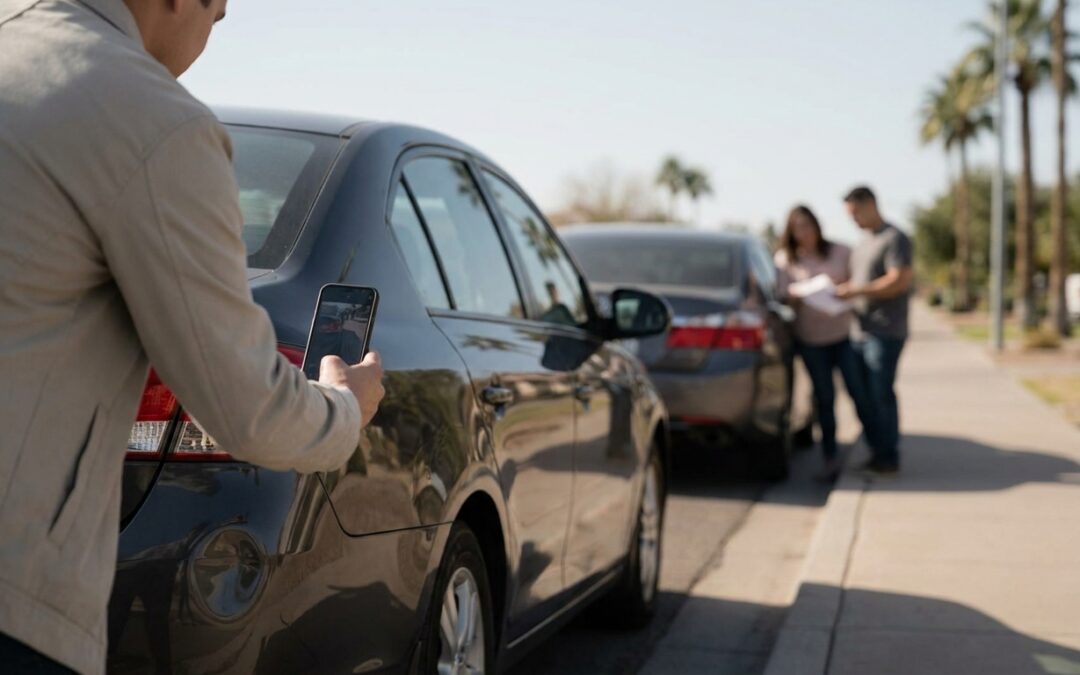
- Take 20–30 photos. Wide shots of both vehicles from multiple angles. Close-ups of every damaged surface. Photos of the road, skid marks, debris, traffic signs, traffic signals, and weather conditions. Take more than you think you need.
- Get the other driver’s info:
- Full name and date of birth
- Phone number and address
- Driver’s license number (photo of the license, both sides)
- Insurance company name + policy number (photo of the insurance card)
- Vehicle make, model, year, color, and license plate (photo of plate)
- Get witness info. Names, phone numbers. Witnesses disappear fast. Ask anyone who saw it.
- Note the exact location: cross streets, mile markers, business names.
- Note time and weather conditions.
- Don’t share too much. Don’t discuss fault, your insurance limits, or whether you’re going to file a claim. Exchange info, take photos, be polite, move on.
Call the Police
In Arizona, you must report an accident if there are injuries, fatalities, or property damage estimated above $1,000 (most fender benders cross this threshold easily). Even if it’s under that, a police report makes the insurance process dramatically smoother.
Gilbert PD: (480) 503-6500
Mesa PD: (480) 644-2211
Chandler PD: (480) 782-4130
Tempe PD: (480) 350-8311
Queen Creek (Maricopa County Sheriff): (602) 876-1011
Apache Junction PD: (480) 982-8260
When the officer arrives, tell them the facts only. Don’t speculate or apologize. The officer will write a report (called a DR-1 in Arizona) and give you a report number — write it down. You’ll need it for everything that comes next.
The First 24 Hours
Step 1: Call Your Insurance Company
File the claim as soon as you’re home and safe. The longer you wait, the harder it gets to substantiate. Have ready:
- Police report number
- Photos you took at the scene
- Other driver’s name, contact, and insurance info
- Description of what happened (facts only)
- Names and contact info of any witnesses
Step 2: Get Medical Attention If Anything Hurts
Adrenaline masks pain. Some injuries (whiplash, concussion, soft-tissue) don’t fully manifest for 24–72 hours. If anything hurts even slightly, see a doctor and document it. This matters for both your health and any future bodily injury claim.
Step 3: Make a Plan for Repair
Even if you’re still gathering information, start thinking about where you want the vehicle repaired. You have the right to choose your shop in Arizona under ARS §20-469. Insurance companies will steer you to their “preferred” or “direct repair” shops, but you are not required to use them. More on insurance claim navigation here.
Need an Estimate to Push Back on a Lowball Insurance Offer?
Send us photos of the damage. We’ll write you an honest, itemized estimate you can use to negotiate the actual scope of repair with the adjuster.
The First Week: Working With Insurance
Whose Insurance Pays?
In Arizona (an at-fault state), the at-fault driver’s insurance is responsible for damages to the not-at-fault driver. Your options:
- If the other driver is at fault: file a third-party claim with their insurance for property damage, medical bills, lost wages, and (if your car is newer) a diminished value claim.
- If you’re at fault or split fault: file under your own collision coverage if you have it. You pay your deductible, the rest is covered.
- If the other driver is uninsured or unidentified (hit and run): file under your uninsured motorist property damage (UMPD) coverage if you have it; otherwise collision.
- If there’s a dispute over fault: both insurers investigate. The police report is usually the deciding factor.
The Adjuster Inspection
An adjuster will inspect your vehicle (in person or by photos). They’ll write an initial estimate. Do not assume this is the final number. Initial estimates almost always miss damage that’s only visible after disassembly, and they typically use the cheapest aftermarket parts pricing. A real body shop will write supplements during the repair to capture what the initial estimate missed.
Choose Your Shop
Pick a shop you trust. Get an estimate. Have the shop talk directly to the adjuster about scope. A good shop fights for the right scope; a steered shop accepts whatever the insurer dictates. You’re entitled to OEM parts, real paint match, and complete repair — not a budget version.
↓ Free Post-Accident Consultation
Just had an accident and not sure what to do next? Send us a quick description, photos of the damage, and your situation (filed claim, no claim yet, etc.). We’ll send you a clear plan and a written estimate within one business day. Free.
Common Mistakes That Cost People Money
- Admitting fault at the scene. Even “I’m sorry” can be used against you.
- Not taking enough photos. You can’t go back to the scene later.
- Skipping the police report. Without it, insurance disputes turn into he-said-she-said.
- Accepting the first insurance check. First offers are almost always low.
- Signing a release before repair is complete. Once you sign, you’re typically done — even if hidden damage shows up later.
- Letting the insurer pick your shop. You have the legal right to choose. Use it.
- Forgetting about diminished value. If you weren’t at fault and your car is newer, the at-fault driver’s insurance owes you for lost market value. See our DV claim guide.
- Not getting a post-repair inspection after a major collision, especially involving frame work.
- Driving a vehicle with possible frame or structural damage before it’s been measured.
The Repair Process: What to Expect
Step 1: Tow or Drive to the Shop
If the vehicle isn’t safely drivable, arrange a tow. Most insurance policies cover towing as part of the claim. Tow it directly to your chosen shop, not to a holding yard the insurer suggests — storage fees add up fast and can become a dispute.
Step 2: Estimate + Supplements
The shop writes an initial estimate. As they disassemble the vehicle, they discover what was hidden — bent inner panels, damaged sensors, structural cracks — and write supplements. The insurer reviews and approves.
Step 3: Parts Ordering
OEM, OEM-equivalent, or aftermarket parts get ordered. Quality shops prioritize OEM where possible. Lead times vary — some parts ship same day, some take weeks.
Step 4: Repair
Body work, structural repair (if needed), refinish, and reassembly. Modern repairs include sensor recalibration and ADAS verification.
Step 5: Quality Control + Delivery
Final inspection, test drive, alignment if applicable. Vehicle is delivered with a walk-around explaining what was done.
Step 6: Post-Repair
For major repairs, especially structural, consider an independent post-repair inspection to verify the work. File any diminished value claim before signing the final insurance release.
Why Choose Network Collision Repair After an Accident
- 30 years of post-accident experience. We’ve handled every claim scenario — minor scratches to major structural rebuilds.
- We talk to your insurance for you. One less phone call you have to make.
- Frame measuring system on-site for vehicles with potential structural damage.
- Spectrophotometer paint matching so the repair is invisible.
- ADAS recalibration in-house — we don’t sublet.
- Lifetime workmanship warranty on every repair.
- Rental coordination — we’ll help line up your loaner under your policy.
- Family-owned, Gilbert local. Read more on the About page.
After-Accident FAQ — Gilbert, AZ
Do I have to call the police for a minor accident?
In Arizona you must report any accident involving injury, fatality, or estimated property damage over $1,000. Most fender benders cross that threshold. Even when it’s technically below, a police report makes the insurance side dramatically smoother — we recommend calling every time.
What if the other driver doesn’t want to involve insurance?
Politely insist on exchanging insurance info regardless. People often regret cash deals because hidden damage surfaces during disassembly and the other driver stops answering calls. Your insurer cannot help you without their insurance information.
Can I pick my own body shop?
Yes. Arizona law (ARS §20-469) explicitly protects your right to choose your repair shop. The insurer can recommend; they cannot require.
How long after an accident can I file a claim?
Most insurers want notification within 30 days. Arizona’s statute of limitations for property damage is 2 years, but waiting is rarely a good idea — documentation gets harder.
Will my insurance go up?
If you’re at fault, usually yes. If the other driver is at fault and you’re filing against their insurance (third-party), generally no — though some carriers do consider not-at-fault claims at renewal. UMPD claims for hit and runs usually don’t affect rates.
What if I’m hit by an uninsured driver?
If you carry uninsured motorist property damage (UMPD) coverage, file under it. UMPD is optional in Arizona — if you have it, your deductible is usually lower and the claim doesn’t count against you. Without UMPD, you file under collision or pursue the at-fault driver in civil court.
Do I have to get my car towed to where insurance wants?
No. Have it towed directly to the shop you choose. Insurer-recommended holding yards often charge storage fees that get disputed later.
What if I disagree with the insurance estimate?
Bring it to a shop you trust. Have them write their own estimate. Then have the shop talk directly to the adjuster to negotiate scope. Supplements are common during disassembly. You also have the right to invoke the appraisal clause in your policy if you have one.
Do you serve Mesa, Chandler, Tempe, and Queen Creek?
Yes. Network Collision Repair is at 1021 N Gilbert Rd Unit 105, Gilbert, AZ 85234. We serve the entire East Valley.
One Call. We’ll Handle the Rest.
If you’ve just been in an accident in Gilbert, Mesa, Chandler, Tempe, or Queen Creek — take a breath. Call us. We’ll walk you through the next 24 hours, talk to your insurance, and have your car back like nothing happened.
Or call us directly at (480) 691-2299 · 1021 N Gilbert Rd Unit 105, Gilbert, AZ 85234
Related reading: Insurance Claim Help · Hit and Run Repair · Rear End Collision · Frame Repair · Diminished Value Claim · Post-Repair Inspection · All Services