
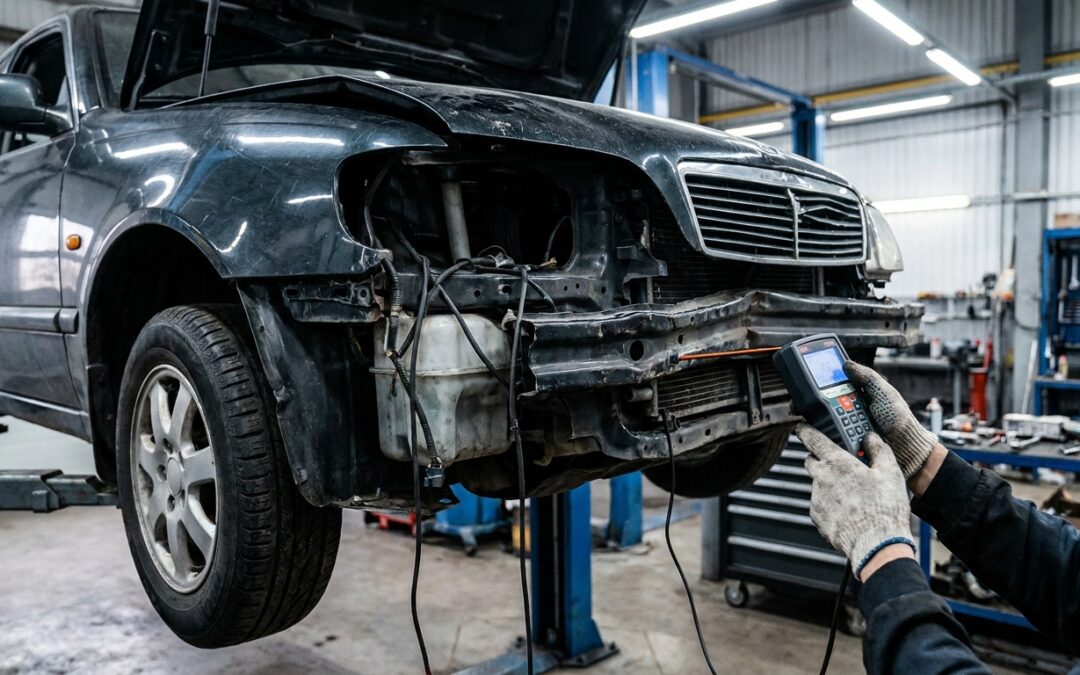
Structural Damage Inspection After Accident: 2026 (7 Signs)
Search “structural damage inspection after accident” and you’ll mostly get results about home foundation inspections and fleet-management software. None of that helps you if you were just in a wreck and your insurance adjuster’s quick walk-around estimate didn’t look underneath the car. A proper structural damage inspection after an accident is not a visual guess. It’s a measured, documented check of your vehicle’s frame, crumple zones, and mounting points against factory specifications. Here’s what that inspection actually covers, the signs that tell you one is overdue, and why skipping it can cost you far more than the inspection itself.
Network Collision Repair is a family-owned body shop on Gilbert Road, repairing East Valley vehicles since 1995. We put a car on our computerized measuring system before we write a final estimate on anything beyond a cosmetic scuff, because the parts of a car that got hit hardest are usually the parts nobody can see without the right equipment.
Most drivers never think about structural inspection until something feels wrong weeks after a repair they thought was finished. By then, the insurance claim may already be closed, the rental car may already be returned, and the conversation about who pays for a second round of work gets a lot harder. The information below is meant to be read before you sign off on a repair, not after something starts rattling.
Not Sure If Your Car Needs a Structural Check?
Bring it in and we’ll put it on the measuring system. Free estimate, no pressure, no obligation to repair with us.
What a Structural Damage Inspection Actually Involves
Every modern car is engineered to manage a crash in a very specific way. The front and rear sections are built as crumple zones, designed to collapse and absorb impact energy before it reaches you. The passenger compartment is built as a rigid safety cage, tied together by frame rails, rocker panels, and reinforced pillars that are supposed to stay straight no matter what happened in front of or behind them.
When any of that gets bent, even slightly, the car’s crash protection for the next accident is compromised, whether or not the damage is visible from the driveway. A real structural inspection checks three things a visual estimate cannot:
- Frame and unibody alignment – whether the rails, subframe, and mounting points sit where the manufacturer’s spec says they should, measured in millimeters, not eyeballed
- Crumple zone integrity – whether the energy-absorbing sections that already did their job are still capable of doing it again
- Hidden component damage – radiator supports, suspension mounts, and safety systems that sit behind a bumper cover that looks fine
See our frame damage repair guide for more on the unibody-vs-ladder-frame distinction and how a bent frame specifically gets measured and corrected.
Unibody vs. Body-on-Frame: Why the Construction Changes the Inspection
Most sedans, crossovers, and smaller SUVs on the road today use unibody construction, where the body panels and the structural frame are a single welded shell. Hit one corner hard enough and the stress can travel through that shell and show up as a misalignment somewhere else entirely, like a door gap on the opposite side of the car. Trucks and larger body-on-frame SUVs have a separate ladder frame bolted underneath the body, which behaves differently under impact and can hide a bent frame rail beneath a body that still looks straight.
Both designs need the same thing after a real impact: a measurement against factory tolerances, not a guess based on what the construction “usually” does in a crash like this one.
What Hides Behind a Bumper Cover
A plastic bumper cover is a cosmetic skin. Behind it sits a steel or aluminum reinforcement bar, energy-absorbing foam, the radiator support, headlight and sensor mounts, and on many newer vehicles a forward-facing camera or radar unit for adaptive cruise and automatic braking. A bumper cover can pop back into a shape that looks acceptable while everything behind it absorbed real force. That’s one of the most common places we find damage an insurance photo estimate missed entirely, because the photo only shows the skin.
| Check | Visual / Photo Estimate | Structural Inspection |
|---|---|---|
| What’s examined | Visible panels, paint, obvious cracks | Frame rails, mounting points, crumple zones, hidden brackets |
| How it’s measured | By eye, from photos or a walk-around | Computerized 3D measuring against factory spec, in millimeters |
| Safety systems | Usually not scanned | Airbag, seatbelt pretensioner, and ADAS modules scanned for fault codes |
| Documentation | A price per visible item | A written report with measurements, useful for claims and resale |
| Time required | Minutes | Under an hour on the measuring system, same-day report |
How Network Collision Inspects for Structural Damage
We don’t eyeball this. The process looks like:
- Visual and tactile walk-around – panel gaps, paint creasing, tire wear patterns, anything that hints at a problem beneath the surface
- Computerized 3D measuring – the car goes on our electronic measuring system, which compares hundreds of factory reference points against the manufacturer’s original specifications and shows exactly where, and by how much, anything is out of tolerance
- Pull and stress check – for suspected frame damage, we check how the structure responds under controlled force, since a frame can look straight and still be weakened
- Diagnostic scan – airbag modules, seatbelt pretensioners, and ADAS sensors get scanned for fault codes that a dashboard light doesn’t always show right away
The result is a written report with actual measurements, not an opinion. That report is what you hand your adjuster, and it’s also what protects you if hidden damage turns up later. If you’ve already had repairs done elsewhere and want a second set of eyes, our post-repair inspection service covers exactly that.
7 Signs You May Have Hidden Structural Damage
- Doors, hood, or trunk don’t close flush or need extra force to latch. A door that used to close with a light push and now needs a slam is a classic sign that the opening it fits into has shifted shape, even slightly.
- Uneven panel gaps around doors, fenders, or the hood that weren’t there before the accident. Stand at the front corner of the car and sight down the gap between the hood and fender on both sides. They should match.
- The steering wheel sits off-center when driving straight down a flat road. This often points to a bent tie rod, a shifted subframe, or a frame that’s no longer square, not just an alignment that needs adjusting.
- The car pulls to one side or wanders with light steering input, even on a road with no crown or wind.
- Uneven or rapid tire wear on one side after the collision, which can mean a suspension mount or control arm took damage that an alignment alone won’t fix.
- A warning light for airbags, ABS, or stability control that wasn’t on before, or that came on days after the accident rather than immediately.
- Wind noise or water leaks that appeared after the crash, suggesting a seal, weatherstrip, or panel is no longer sitting flush where it should.
Any one of these on its own could be something small and unrelated. More than one together, showing up after a collision, is a strong reason to get on the measuring system before the window to amend an insurance claim closes.
↓ Had an Insurance Estimate That Didn’t Mention the Frame?
Send us a quick note with your estimate and we’ll tell you honestly whether a structural inspection makes sense for your situation. No obligation.
Why a Drive-By Estimate Isn’t Enough
Most initial insurance estimates, whether written by an adjuster in a parking lot or generated from photos you submitted through an app, are visual. They price what’s visible: a dented fender, a cracked bumper, a broken headlight. They are not measuring your frame rails or putting the car through a diagnostic scan, because that process takes equipment and time a five-minute photo estimate doesn’t allow for.
That gap is exactly where structural damage hides. A bumper that absorbed the initial hit can look repairable for a few hundred dollars while the subframe behind it is out of alignment by a centimeter, a problem that costs thousands and changes how the car protects you in the next accident. You have the right in Arizona to have your vehicle inspected and repaired at the shop you choose, not just the one that wrote the first number.
This isn’t a knock on adjusters doing their jobs. A visual or photo estimate is a reasonable starting point for a fender scuff with no other symptoms. The problem is when that same quick process gets applied to a harder hit, a rear-end collision at speed, a T-bone, or anything where airbags deployed, and the resulting number becomes the only figure anyone looks at before the car goes back on the road.
What Happens After the Inspection
If the measuring system comes back clean, you have documentation that your car is structurally sound, which is worth having on file even if you never need it. If it finds damage, there are two paths depending on severity and cost relative to the vehicle’s value:
- Repair: the frame or unibody section gets pulled back to factory tolerances on the measuring system, reinforced sections get replaced rather than just straightened where OEM procedure calls for it, and the car goes back on the system afterward to confirm it’s within spec before paint and reassembly.
- Total loss evaluation: if the cost of a proper structural repair approaches or exceeds the car’s value, the honest conversation shifts to whether your insurer should total the vehicle instead. We’ll tell you plainly which side of that line your car is on.
Either way, you’re making that decision with real measurements in hand instead of a guess.
What Structural Repair Can Cost
Once an inspection finds a problem, the fix ranges widely depending on severity. As a general guide for the East Valley market in 2026: minor frame straightening starts around $1,200, while a severe structural rebuild involving multiple rails, mounts, and reinforced sections can run as high as $14,000. The inspection itself, and the honest conversation about whether repair or total loss makes more sense, is what determines where in that range your car actually lands. If the number comes back high relative to your car’s value, our guide on when a car is totaled in Arizona walks through what happens next.
Get a Written Structural Report
We’ll put your car on the measuring system and give you a documented report you can use with your insurance company or just for your own peace of mind.
Why Choose Network Collision for a Structural Inspection
We’re an independent, family-owned shop, not a Direct Repair Program location tied to any one insurance company’s targets. That matters here specifically: a shop under pressure to hit an insurer’s turnaround numbers has less incentive to spend an extra hour on the measuring system for a car that “looks fine.” We work for you, not the carrier, and we’ll tell you plainly if your car checks out clean or if it doesn’t.
If the inspection does turn up damage, we handle the insurance claim conversation directly, including writing supplements for anything the original estimate missed.
Our measuring equipment stays on-site, not subbed out to a third party we don’t control. That means the same shop that finds the damage is the shop with full visibility into fixing it correctly, with one team accountable for the result from the first measurement to the final alignment check.
Structural Damage Inspection FAQ – Gilbert, AZ
How do I know if my car has structural damage after an accident?
Look for the signs above: misaligned panels, doors that don’t close right, an off-center steering wheel, pulling to one side, or new warning lights. The only way to know for certain is a computerized measuring check against factory specifications, since structural damage is frequently invisible from the outside.
Can structural damage show up weeks after the accident?
Yes. A frame or suspension mount that’s slightly out of alignment can seem fine for a few weeks of driving before the symptoms become obvious, which is why a car that “drove home fine” isn’t proof that nothing is wrong underneath.
Will my insurance pay for a structural inspection?
In most cases, yes, as part of a legitimate collision claim. If your insurer’s initial estimate didn’t include a measuring-system check, we can write that into the supplement and work directly with your adjuster to get it covered.
Is it safe to drive my car with suspected frame damage?
Not until it’s been checked. A compromised frame or crumple zone may not hold up correctly in a second collision, even a minor one, and symptoms like pulling or an off-center wheel can also point to a safety issue with steering or suspension.
How long does a structural inspection take?
The measuring and diagnostic portion typically takes under an hour once the car is on the system. The full visit, including the walk-around and a written report, usually wraps up the same day.
What happens if the inspection finds damage my insurer’s estimate missed?
We document it with measurements and write a supplement to your claim. This is a routine part of collision repair, not a confrontation, and it’s how a fair number of claims end up paying for more than the first estimate suggested.
Do I have to use my insurance company’s preferred shop for the inspection?
No. Arizona law lets you choose your own shop regardless of which one your insurer recommends. An independent shop has no financial relationship with the carrier pushing it toward a faster, cheaper number.
Does a clean accident history report mean my car has no structural damage?
No. Accident history reports are built from insurance claims, police reports, and auction records. A low-speed collision that was never reported, or was handled without filing a claim, won’t appear on that report even if it left real damage behind. The measuring system checks the car in front of you, not its paperwork.
What if I already repaired the car somewhere else and now something feels off?
Get a second opinion before you accept that the repair is finished. A post-repair inspection checks the original shop’s work against factory tolerances and gives you documentation to go back to them, or to your insurer, if something was missed.
Do you serve Mesa, Chandler, Tempe, and Queen Creek?
Yes. Network Collision Repair is at 1021 N Gilbert Rd Unit 105, Gilbert, AZ 85234 and serves the entire East Valley.
Don’t Guess About What’s Underneath
A visual estimate tells you what happened to the outside of your car. A structural inspection tells you what happened to the part that keeps you safe. If you were in an accident in Gilbert, Mesa, Chandler, Tempe, or Queen Creek, get it checked before you sign off on any repair.
Or call us directly at (480) 691-2299 · 1021 N Gilbert Rd Unit 105, Gilbert, AZ 85234
Related reading: Frame Damage Repair Gilbert AZ · Post-Repair Inspection · Insurance Claim Help · What to Do After an Accident · When Is a Car Totaled in Arizona · All Services