
Front-End Collision Damage Repair Gilbert AZ: 2026 Guide [4 Safety Checks]
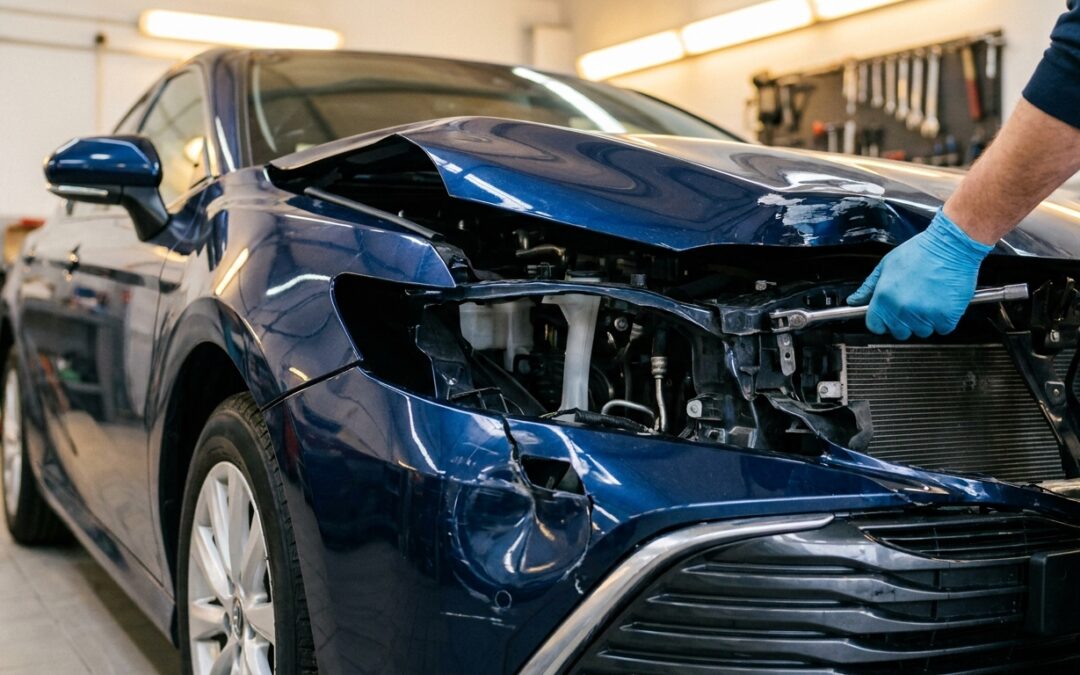
A crushed front clip is one of the more intimidating things to look at after an accident — a hood buckled up, a bumper hanging, maybe steam rising from a cracked radiator. The good news is that most front-end damage, even damage that looks severe, is repairable. The part that matters is what’s underneath the visible mess: the radiator support, the sensors packed into the bumper and grille, the airbag system, and whether the impact reached the frame rails. This guide walks through what a crushed front end really involves, whether the car is safe to drive, and how the estimate and insurance claim actually unfold from a Gilbert body shop’s bench.
Network Collision Repair has been a family-owned body shop on Gilbert Road since 1995, working under our parent company Network Automotive. Front-end collisions are one of the most common repairs we see — parking lot nose-to-nose taps, intersection collisions, and the occasional guardrail or curb strike from East Valley drivers.
What a Crushed Front End Actually Involves
The front of a modern vehicle is engineered to crumple in a very specific, controlled way. That’s a good thing — it’s what protects the people inside the car. It also means a hard front-end hit touches a lot more than the bumper cover and headlights you can see standing in the driveway. Here’s what we check on every front-end vehicle that comes through the shop:
- The radiator support. This is the structural frame that holds the radiator, condenser, and often the headlights and front bumper reinforcement bar in place. It’s one of the first things to bend or crack in a front-end hit, and if it’s out of alignment, nothing bolted to it will line up correctly afterward.
- Cooling system components. Radiators, AC condensers, and cooling fans sit directly behind the bumper and are frequently punctured or cracked even in moderate hits — this is often the reason a car overheats on the drive home from a “minor” accident.
- Sensors and cameras. Forward-facing radar, parking sensors, and cameras used for automatic emergency braking and adaptive cruise control are commonly mounted in the grille, bumper, or behind the windshield near the front of the car. A hit hard enough to crack the bumper is often hard enough to knock these out of calibration.
- Airbag sensors and modules. Front-impact sensors are usually mounted near the radiator support specifically so they can detect a serious hit early. Even if the airbags didn’t deploy, damaged or displaced sensors need to be inspected before the system can be trusted again.
- Headlight aim and housings. Headlight assemblies that survive a hit cosmetically can still be knocked out of proper aim, which is both a safety issue and something Arizona vehicle inspections can flag.
- The hood and its latch mechanism. A buckled hood might still close, but the latch and safety catch underneath can be bent just enough that it doesn’t fully engage — something that isn’t obvious until the hood pops open unexpectedly at speed.
- Exhaust and undercarriage components. On harder hits, force can travel down into the exhaust manifold, catalytic converter, or front subframe mounts, especially on lower-profile sedans and sports cars.
- The frame rails themselves. On a harder hit, force travels back into the unibody structure. See our frame damage repair guide for how we measure to confirm whether this happened.
Front-end collisions cluster around a few predictable East Valley scenarios: rear-ending isn’t the only intersection risk, and a stopped or slow-moving car can just as easily be the one that gets hit head-on by a driver who ran a light on Gilbert Road, Baseline, or Val Vista. Parking lot nose-to-nose taps outside shopping centers near the 202 are another common source — low speed, but the bumper, grille, and radiator support absorb the hit directly. And on the 60 or the 202 itself, higher-speed front-end impacts are more likely to reach the frame rails and require the kind of structural measuring covered in our frame damage guide.
Just Had a Front-End Collision in Gilbert?
Send us photos or bring the car in and we’ll give you a written estimate covering the full scope, not just the visible bumper and hood damage.
Is It Safe to Drive After a Front-End Hit? 4 Things to Check
Don’t Just Look — Check These
- Is the car leaking fluid or running hot? A cracked radiator or a punctured AC condenser can look like a minor drip at first and turn into an overheated engine a few miles down the road. If the temperature gauge climbs or you smell coolant, stop and have it towed.
- Is a warning light on — airbag, check engine, or ABS? Any of these lit up after a collision means a system needs to be scanned before the car is trusted for daily driving, even if it still runs fine.
- Do the headlights aim correctly and does the hood latch securely? A hood that isn’t fully latched can fly open at speed. Misaimed headlights are a safety and legal issue after dark.
- Is there any unusual noise, pulling, or vibration when braking or steering? This can point to suspension or steering components bent in the impact, which affects how the car handles well beyond what’s visible from outside.
If any of these show up, the safest move is a flatbed tow rather than driving it in, even for a short distance. If none of them show up, the car is likely fine to drive to our shop or your home, but that doesn’t mean there isn’t hidden damage worth a proper inspection before you settle the claim.
It’s worth being honest about the temptation here: after a stressful accident, a car that starts, drives straight, and doesn’t smell like coolant feels like a relief, and it’s easy to talk yourself into “it’s probably fine.” The four checks above exist specifically because “probably fine” and “actually fine” aren’t the same thing on a modern vehicle. A radiator support out of alignment by a few millimeters won’t announce itself with a warning light — it’ll show up as a headlight that sits slightly crooked, a hood gap that’s uneven side to side, or a slow coolant loss that only becomes obvious a few weeks later when the Arizona heat pushes the cooling system harder.
How the Estimate and Insurance Claim Actually Unfold
Front-end damage tends to generate more back-and-forth with insurance than a simple bumper scuff, mostly because there’s more potentially hidden underneath. Here’s the typical sequence:
- Initial estimate. We write a scope based on visible damage plus what we expect to find once the bumper cover and any damaged panels come off — radiator support condition, sensor and airbag system status, and frame alignment on harder hits.
- Teardown and supplement. Once we’re into the vehicle, we document anything additional we find with photos and submit a written supplement to the insurer. This is the single biggest reason front-end repairs run over an initial phone-quoted estimate — there’s simply more to find.
- Parts sourcing. Radiator supports, condensers, and sensor-equipped bumpers can have longer lead times than cosmetic parts. We’ll give you a realistic timeline once parts are ordered rather than guessing.
- ADAS calibration and final inspection. Any camera or sensor involved in driver-assist features gets tested and recalibrated as part of the repair, not left for you to discover later.
One detail that surprises a lot of drivers: a front-end estimate written before disassembly is really a starting point, not a final number. Insurance estimating software prices what a photo or a quick walk-around can see. It has no way to know whether the radiator support is bent two millimeters out of spec, or whether a wiring harness behind the headlight was crushed, until a technician actually has the panels off. That’s why a shop willing to tear the vehicle down before finalizing the number tends to produce a more accurate first estimate than one that quotes from photos alone — and why supplements are a normal, expected part of a proper front-end repair rather than a sign something’s wrong.
If you’re filing against another driver’s insurance rather than your own, you’re not obligated to use whichever shop their adjuster suggests — Arizona law gives you the right to choose your own repair shop. We’re an independent, non-DRP shop, so our estimate reflects what your car needs rather than a carrier’s negotiated template. More on that process is on our insurance claim help page, and our what to do after an accident guide covers the steps to take at the scene.
Not Sure If the Estimate You Got Covers Everything?
Bring it by for a second opinion. We’ll look at what’s actually underneath the bumper before you sign off on a number.
What Front-End Repair Typically Costs
Front-end repairs cover a wide range depending on how far the damage reaches. Here’s an honest 2026 range for the East Valley:
| Type of Damage | Typical 2026 Range |
|---|---|
| Minor dent or crease, paint intact (PDR) | $75 – $500 |
| Bumper cover repair or replacement and repaint | $150 – $1,800 |
| Hood or fender refinish/replacement | $400 – $900 |
| Structural repair (radiator support, frame rail pull) | $1,200 – $14,000 |
Sensor and ADAS recalibration, headlight assemblies, and cooling system parts are typically priced as separate line items specific to your vehicle. On harder hits where the structural repair range applies, it’s worth understanding when a car is considered totaled in Arizona before agreeing to a number with the insurer.
The biggest driver of where a given repair lands in these ranges isn’t the make or model — it’s how far the impact reached. A hit that stops at the bumper cover and grille stays cheap. A hit that reaches the radiator support pulls in cooling system parts and possibly sensor recalibration. A hit that reaches the frame rails is a different conversation entirely, involving electronic measuring and, in some cases, a total-loss discussion with the insurer rather than a straightforward repair.
↓ Want a Written Estimate Before You Talk to the Adjuster?
Send us photos of the damage and a quick description of what happened. We’ll get back to you with a written estimate you can bring into the claims conversation. No obligation.
Why East Valley Drivers Choose Network Collision for Front-End Repairs
- Family-owned since 1995. Three decades repairing East Valley vehicles under one roof means we’ve seen just about every version of front-end damage this climate and this traffic can produce.
- Independent, non-DRP shop. We don’t answer to an insurance carrier’s pricing template — Arizona law gives you the right to choose your own shop regardless of what your insurer suggests, and we work the claim on your behalf, not the carrier’s.
- We look before we quote. Bumper covers and damaged panels come off before the estimate is final, so supplements are documented with photos, not a surprise sprung on you mid-repair.
- Sensor and ADAS testing on every front-end repair. Not just when a customer specifically asks about it — it’s part of the standard process on any vehicle with driver-assist features.
- Written, itemized estimates. You’ll know exactly what’s being replaced, repaired, or refinished, and why, before any work starts.
- All-makes shop. Sedans, SUVs, and pickup trucks all come through our doors — see our truck collision repair page if it’s a work truck.
Front-End Collision Repair FAQ — Gilbert, AZ
Is my car safe to drive after a front-end collision?
It depends on what’s damaged. Check for fluid leaks, an overheating gauge, dashboard warning lights, a hood that won’t latch securely, and any pulling or vibration when braking or steering. If any of those show up, have the car towed rather than driven.
Why did my radiator start overheating after a “minor” front-end hit?
Radiators, AC condensers, and cooling fans sit directly behind the bumper cover and are commonly punctured or cracked even in impacts that don’t look severe from outside. A slow coolant leak can take a few miles to show up as an overheating gauge.
Do I have to use the shop the other driver’s insurance recommends?
No. Arizona law gives you the right to choose your own repair shop, including on a claim filed against the at-fault driver’s insurance. You can bring your car to Network Collision Repair regardless of which shop the adjuster suggests.
Will my airbags need to be replaced even if they didn’t deploy?
Not necessarily, but the sensors and modules that control them need to be inspected. A hit hard enough to damage the radiator support can also displace or damage impact sensors mounted nearby, and those need to check out before the system is trusted.
How long does a front-end repair usually take?
It depends heavily on parts availability. Cosmetic bumper and headlight repairs can move quickly; a radiator support replacement or frame straightening job with backordered parts can extend the timeline. We’ll give you a realistic estimate once parts are ordered.
Does insurance cover ADAS sensor recalibration after a front-end hit?
In most cases, yes, when it’s documented as required by the collision damage. We test and note when a system needs recalibration so it’s included in the estimate rather than skipped.
What if the repair cost is close to my car’s value?
Front-end hits that reach the frame rails can push repair costs close to a vehicle’s value, especially on older cars. Read our guide on when a car is totaled in Arizona to understand the threshold insurers use.
Do you serve Mesa, Chandler, Tempe, and Queen Creek?
Yes. Network Collision Repair is located at 1021 N Gilbert Rd Unit 105, Gilbert, AZ 85234, and we repair front-end collision damage for drivers across the entire East Valley.
Get the Full Picture Before You Settle the Claim
A crushed front end is rarely just a bumper and a hood. Let us take it apart, document what we find, and give you a written estimate that reflects the whole repair.
Or call us directly at (480) 691-2299 · 1021 N Gilbert Rd Unit 105, Gilbert, AZ 85234
Related reading: What to Do After an Accident · Insurance Claim Help · Frame Damage Repair · Post-Repair Inspection · When Is a Car Totaled in Arizona · All Services