
Frame Damage Repair Gilbert AZ: What Every Driver Should Know in 2026
A bumper that pops back into shape and a hood that closes fine can still be hiding the most serious kind of collision damage there is. Frame damage doesn’t always look dramatic — but it changes how your car handles, how it protects you in the next crash, and how much your insurer is willing to pay. If you’ve been in a moderate-to-serious wreck anywhere in Gilbert, Mesa, Chandler, Tempe, or Queen Creek and something about the car feels “off,” this guide walks through what frame damage actually is, how a shop proves whether yours is straight, and what it means for your claim.
Network Collision Repair is a family-owned collision shop on Gilbert Road that has been straightening frames and unibody structures for East Valley drivers since 1995. We measure every structural repair on an in-house computerized system rather than eyeballing it or subletting the work out — which matters a lot once you understand what’s actually at stake with a bent frame. For the broader picture of what to check in any shop doing this kind of work, see our buyer’s guide to picking a body shop in Gilbert.
Think Your Frame Might Be Bent?
Bring the car in and we’ll put it on the measuring system and give you a written estimate on what it will take to bring it back to spec. Free, no pressure.
What “Frame Damage” Actually Means
The term gets used loosely, but there are really two different structures underneath your vehicle, and which one you have changes the whole conversation.
Unibody Construction (Most Cars, Crossovers, and Minivans)
Most passenger cars, crossovers, and minivans on the road today are unibody vehicles — the body panels, floor pan, and structural rails are all one welded-together shell. There’s no separate frame bolted underneath. Instead, the front and rear sections are engineered as crumple zones: they’re designed to fold, buckle, and absorb crash energy in a specific, predictable pattern so the passenger compartment stays intact. When people say a unibody car has “frame damage,” what they usually mean is that the structural rails, aprons, or rocker sections have bent or shifted out of the factory’s designed geometry.
Body-on-Frame (Ladder Frame) Construction
Most pickup trucks and traditional body-on-frame SUVs sit on a separate steel ladder frame, with the body bolted on top. A ladder frame can take a harder hit before it’s structurally compromised, but when it does bend, it usually needs to be pulled and measured just like a unibody rail — and in some cases a section needs to be replaced outright rather than straightened. We cover the truck-specific version of this in more detail on our truck collision repair page.
Either way, the question that actually matters isn’t the terminology — it’s whether the structure is back within the manufacturer’s tolerance. That’s not something you can determine by looking at the car.
How We Prove a Frame Is Straight (or Isn’t)
You cannot tell whether a frame or unibody structure is truly straight by eye, by tape measure, or by whether the doors currently open and close. Modern structural repair is measured, not guessed at.
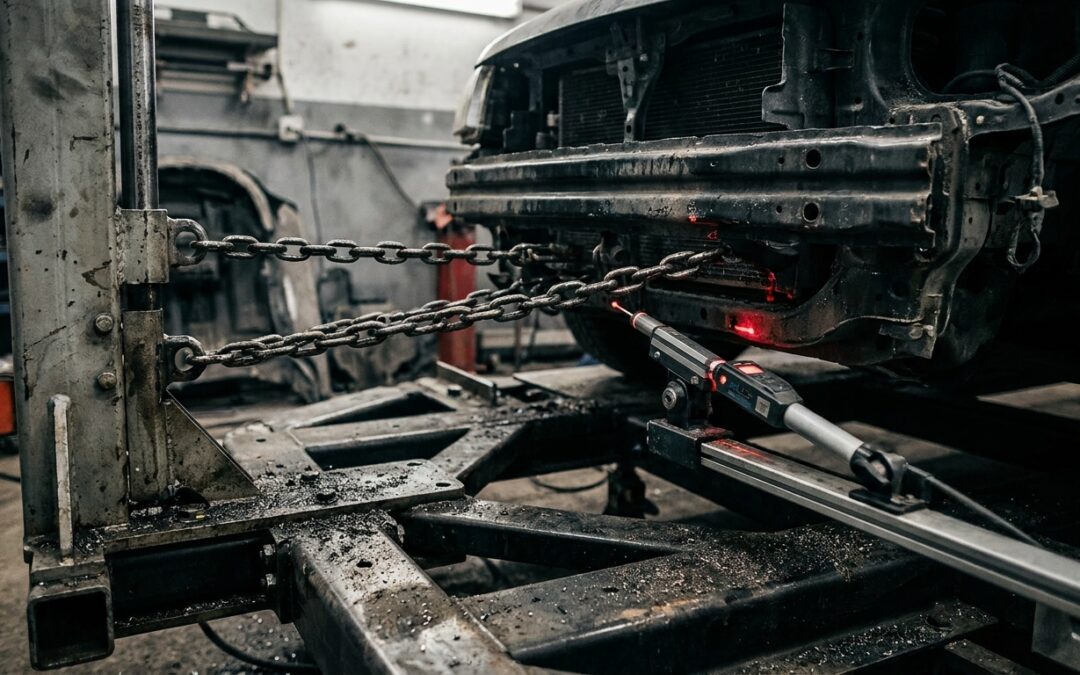
We put the vehicle on a computerized frame measuring system that checks dozens of factory reference points against the manufacturer’s original specifications, down to the millimeter. The system tells us exactly where the structure has moved and in which direction, so the pull equipment can bring it back to true rather than just “close enough to look right.” When the repair is finished, we re-measure and document that every point is back within OEM-spec tolerance before the car ever gets a panel put back on or paint applied. That printout becomes part of your repair record and your insurance file.
A shop without this equipment on-site has to sublet frame work to someone else — which means your car leaves the shop that’s actually managing your repair, and the quality of the straightening depends on whoever that sublet ends up being, not the shop you chose.
7 Signs Your Frame or Structure Might Be Bent
None of these prove frame damage on their own, but any one of them after a moderate-or-worse collision is a reason to get the structure measured before you sign off on repairs, a rental return, or a settlement.
Check For These After Any Moderate-to-Serious Collision
- Doors, hood, or trunk that don’t sit flush or that close with noticeably more effort than before the crash
- Uneven panel gaps — the gap between fender and door, or hood and fender, is wider on one side than the other
- The car pulls to one side under braking or while driving straight, with no steering input
- Uneven or accelerated tire wear appearing within weeks of the accident, especially on one side
- Steering wheel sits off-center when the wheels are pointed straight ahead
- Wind noise or water leaks that weren’t there before, suggesting a gap has opened somewhere in the body
- Visible wrinkles, kinks, or paint cracking along a rail, rocker panel, or apron, even if the panel itself wasn’t replaced
If you’re seeing any of this and the car was recently inspected by an adjuster rather than a shop with a measuring system, it’s worth a second look. Our post-repair inspection page covers how that second opinion works if repairs have already started or finished elsewhere.
Already Have an Estimate That Didn’t Mention the Frame?
Bring it to us. We’ll measure the structure and give you a written second opinion you can compare against what you already have. Free.
What Frame Damage Means for Your Insurance Claim
Structural findings change the shape of a claim in a few predictable ways:
- The estimate grows. A drive-by or photo-based estimate almost never accounts for hidden structural damage. Once the car is measured, the shop typically has to write a supplement covering rail sections, mounts, or suspension points that weren’t visible until the vehicle was on the rack.
- Recalibration gets added. Structural rails often carry mounting points for radar sensors, cameras, and other ADAS hardware. If the geometry around those points moved, the sensors need to be recalibrated after the repair, not just reinstalled.
- Total loss becomes part of the conversation. Once repair costs (including structural work, recalibration, and paint) start climbing, insurers compare that number against the car’s actual cash value. We break down exactly how that threshold works in Arizona in when is a car totaled in Arizona.
- Documentation matters more. A pre- and post-repair measuring printout is concrete evidence for your claim file, whether you’re negotiating a supplement, disputing a total-loss valuation, or just want a record for the next owner if you sell the car.
None of this requires you to use whatever shop your insurer first suggests. Arizona law gives you the right to choose your own repair shop under ARS §20-469, regardless of which shop is on your insurer’s preferred list. An independent shop that isn’t working under a direct-repair-program agreement answers to you, not to the carrier, when it comes to writing the supplement your car actually needs. More on the claims side of this is on our insurance claim help page.
What Frame & Structural Repair Costs in 2026
Every estimate is specific to the vehicle and the damage, but here’s the honest range we see across Gilbert-area structural repairs:
| Severity | Typical Work Involved | Cost Range |
|---|---|---|
| Minor misalignment | Computerized measuring, single-point pull, no parts replacement | $1,200 – $3,000 |
| Moderate structural damage | Multi-point pull, rail or apron sectioning, sensor recalibration | $3,000 – $7,500 |
| Major structural damage | Full rail replacement, core support, suspension mounting points, recalibration | $7,500 – $14,000 |
| Severe damage | Cost frequently approaches or exceeds the vehicle’s value | See our total loss guide |
These numbers assume the vehicle is a repair candidate at all. Part of what a measuring system gives you is an early, honest answer on which category your car falls into — before you or your insurer sink time into an estimate that was never going to hold up.
Why Bring Frame Work to a Family Shop Instead of a Dealer Body Center
Structural repair is one of the areas where it matters most that the shop measuring your car is the same shop standing behind the repair. We’ve been doing this in Gilbert since 1995, as part of Network Automotive, and we keep the frame measuring system in-house specifically so nothing about your structural repair gets handed off to a third party you never met. You can walk in, see the car on the rack, and see the before-and-after measurement printouts yourself.
↓ Want to Know If Your Car Needs a Structural Repair?
Send us a quick note about what happened and we’ll tell you what to look for and get you a free estimate. No obligation.
Frame Damage Repair FAQ — Gilbert, AZ
How do I know if my car’s frame is actually damaged after an accident?
You can’t tell for certain just by looking. Watch for the signs above — uneven panel gaps, doors that don’t close right, the car pulling to one side, or off-center steering — but the only way to know for sure is to have the structure measured on a computerized system against factory specifications.
Can a bent frame be fixed, or does the car have to be totaled?
Most frame and unibody damage can be straightened and repaired. Whether it should be repaired depends on the cost of that repair compared to the car’s actual value. Severe structural damage sometimes pushes the total cost past that threshold, but plenty of moderate structural damage is a completely normal, safe repair.
Will my insurance pay for frame repair?
Yes, structural repair is a covered part of a collision or comprehensive claim when the damage resulted from a covered event. The size of the payout depends on an accurate estimate, which is why a measured diagnosis matters — a photo-based estimate frequently misses structural damage entirely, leading to a low initial number that has to be supplemented later.
How long does frame or structural repair take?
A minor misalignment might be a few days. Moderate-to-major structural work, once you include measuring, pulling, parts sourcing, paint, and recalibration, realistically runs two to four weeks. Anyone quoting a same-week turnaround on real structural work is likely skipping steps.
Is a car actually safe to drive after frame damage is repaired?
It should be, provided the repair was measured and verified against OEM specifications and any affected ADAS sensors were recalibrated afterward. A structural repair that wasn’t properly measured can leave a vehicle out of alignment in ways that affect crash performance in a future accident, even if it drives fine day to day.
What’s the difference between unibody repair and traditional frame repair?
Unibody repair straightens the welded structural rails and sections built into the body itself. Traditional frame repair works on a separate ladder frame that the body is bolted to, common on trucks and older body-on-frame SUVs. The measuring principle is the same either way — both need to be brought back to the manufacturer’s specified geometry, not just made to look right.
Does frame damage hurt a car’s resale value even after it’s repaired?
It can, especially if the damage shows up on a vehicle history report. A documented, professionally measured repair with printouts showing the structure is back to spec is the best defense against that — it gives a future buyer or their inspector concrete proof the repair was done correctly rather than just cosmetically.
Do you serve Mesa, Chandler, Tempe, and Queen Creek for structural repairs?
Yes. Network Collision Repair is at 1021 N Gilbert Rd Unit 105, Gilbert, AZ 85234, and we handle structural and frame repairs for drivers throughout the East Valley.
Don’t Guess on a Bent Frame. Measure It.
If your car has been in a moderate-to-serious collision anywhere in Gilbert, Mesa, Chandler, Tempe, or Queen Creek, get the structure measured before you sign off on any repair or settlement. We’ll put it on the rack, show you the numbers, and give you a free written estimate.
Or call us directly at (480) 691-2299 · 1021 N Gilbert Rd Unit 105, Gilbert, AZ 85234
Related reading: Best Body Shops Gilbert AZ · Truck Collision Repair · Insurance Claim Help · Post-Repair Inspection · When Is a Car Totaled in Arizona · All Services