
Car Paint Matching Gilbert AZ: 2026 Guide [4-Step Match]
“Will the paint match?” is the single most common question we hear before a repair even starts — and it’s the right question to ask. A bad color match is the most visible way a repair can go wrong, because you see it every time you walk up to your car. This guide explains why paint matching is harder than it looks, what actually goes into getting it right, and what to ask any shop before you let them near your car with a paint gun.
Network Collision Repair is a family-owned body shop at 1021 N Gilbert Rd Unit 105 in Gilbert, AZ. We’ve been matching paint in the East Valley since 1995 under our parent company, Network Automotive — long enough to have seen just about every way a color match can go sideways, and to have built a process that avoids it.
Worried a Repair Won’t Match?
Send us photos of the damage and the panel next to it. We’ll tell you honestly what it takes to get a match you can’t see — free, no pressure.
Why “Same Color” Isn’t the Same Paint
Every car has a paint code stamped on a door jamb sticker or under the hood. Punch that code into a mixing system and it spits out a formula. In theory, that should be the end of the story. In practice, it almost never is — and here’s why.
Factory Paint Varies Batch to Batch
Automakers mix paint in huge batches, but pigment concentrations shift slightly from batch to batch, plant to plant, and year to year. A 2021 Camry built in one month can be a hair off from a 2021 Camry built six months later, even though both left the factory wearing the same paint code. Multiply that variance across a used-car market full of vehicles built over several years, and “same code” stops meaning “same color.”
Arizona Sun Does the Rest
Even if two panels rolled off the line with identical paint, they don’t stay identical. Gilbert sees over 300 days of direct sun a year, and UV exposure fades and oxidizes clear coat and base coat unevenly depending on the panel’s angle to the sun, how often the car is washed, and how much time it spends parked outside versus in a garage. A hood and roof that bake in the sun daily can fade noticeably compared to a rear quarter panel that’s shaded most of the day. Fresh paint straight out of the mixing system will always look too new next to a factory finish that’s been sun-baked for three, five, or ten years — unless the shop accounts for it.
Metallics and Pearls Shift With the Angle
Solid colors are relatively forgiving. Metallic and pearl finishes are not. They contain reflective flake or mica particles suspended in the paint, and how those particles are oriented during application changes how the color reads depending on the angle you view it from and how much light is hitting it. Two cans of technically identical metallic paint, sprayed with a different gun technique or a different air pressure, can look noticeably different side by side. This is the single biggest reason DIY touch-up pens and back-alley paint jobs stand out under direct sunlight even when the paint code was correct.
The 4-Step Process We Use to Match Paint
Getting a color match that disappears isn’t about a better paint code — it’s about a process that measures your car’s actual paint instead of trusting a factory number. Here’s what that looks like at Network Collision.
Step 1: Spectrophotometer Read
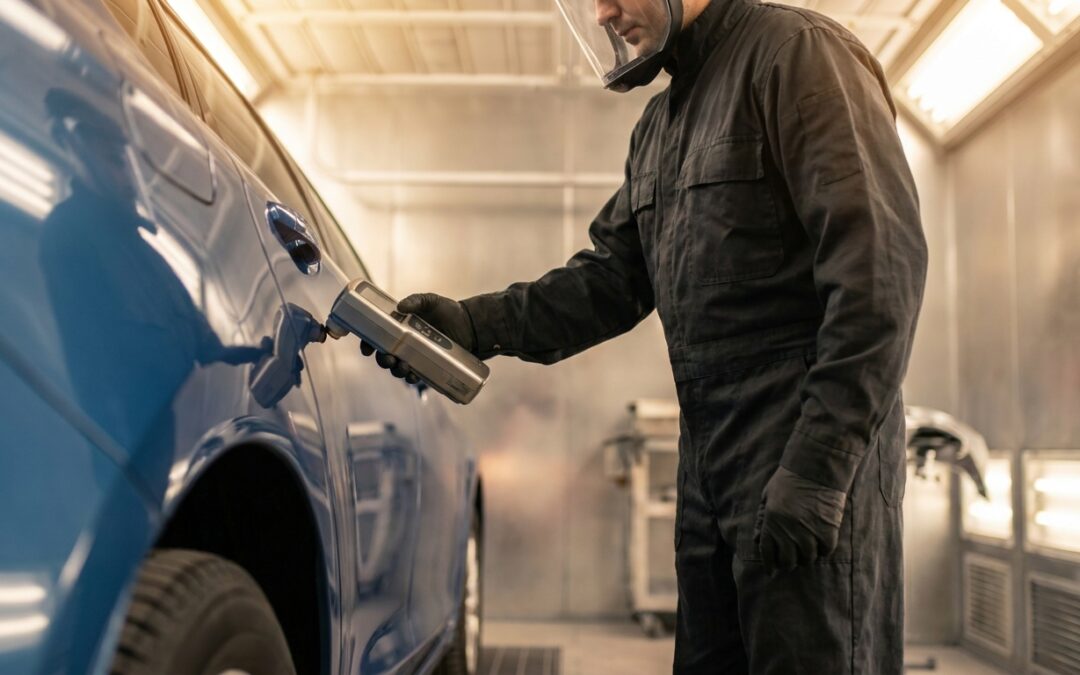
Before we mix anything, we scan your car’s existing paint with a digital spectrophotometer — a handheld instrument that reads the exact color, including how it has faded, right off the panel next to the repair. This isn’t a visual guess. It’s a light-based measurement that captures what the factory paint code alone can’t: how your specific car’s paint has aged in the Arizona sun.
Step 2: Formula Adjustment
The spectrophotometer read gets cross-referenced against the factory paint code and run through a formulation system that suggests an adjusted mix — nudging the toner ratios to account for the fade the scan detected. This is the step a shop skips when it just pulls the factory code off a sticker and mixes it straight.
Step 3: Spray-Out Card Check
Before the mixed paint goes anywhere near your car, we spray it onto a test card and compare it against the actual panel in natural daylight, not shop lighting. Shop lighting can make two different colors look identical and two matching colors look different — daylight doesn’t lie. If the card doesn’t disappear next to your car’s paint, we adjust the mix again before committing paint to metal.
Step 4: Blend Into the Adjacent Panel
Even a perfect formula can leave a visible edge if it stops right at the repair line. For metallics and pearls especially, we blend the new paint into the clear coat of the neighboring panel, softening the transition so there’s no hard edge for your eye to catch. This is standard technique on a quarter panel, fender, or door repair, and it’s the difference between a repair that’s technically the right color and one you genuinely can’t find.
Have a Quote That Didn’t Mention Color Match?
If a shop’s estimate doesn’t mention a spectrophotometer or a blend plan, bring it to us. We’ll give you a second opinion so you can compare line by line. Free.
What Paint Matching Costs in Gilbert (2026)
Color match itself isn’t a separate line item — it’s built into the refinish process on any panel we paint. What changes the cost is how much of the car needs to be sprayed and blended to get there. Here’s what that looks like on a typical 2026 estimate.
| Repair Scope | What’s Involved | Typical Cost Range |
|---|---|---|
| Bumper cover refinish | Plastic bumper prep, spectrophotometer match, single-panel spray | $150 – $1,800 |
| Single-panel refinish | One metal panel (door, fender, hood), color match, clear coat | $400 – $900 |
| Multi-panel blend | Repaired panel plus blend into 1–2 adjacent panels for metallics/pearls | $400 – $900 per panel |
| Structural repair with refinish | Frame/structural work that also requires panel refinish and color match | $1,200 – $14,000 |
These are honest 2026 East Valley ranges, not a quote. Every car and every damage scenario is different — the only way to get a real number is a written estimate on your specific vehicle. If you’re dealing with a scratch rather than a full panel repair, this guide breaks down when a scratch needs a blend versus a spot repair.
Why Choose Network Collision for Color Match
Plenty of shops in the East Valley own a paint booth. Fewer own a spectrophotometer, and fewer still build blending into the estimate by default instead of charging extra for it later. Here’s what we bring to a paint-matching job specifically.
- Spectrophotometer color match on every refinish job — not an upgrade, not an add-on. It’s standard on every car that gets paint from us.
- PPG and Axalta paint systems with UV-stable two-stage urethane, formulated to hold up in Arizona sun instead of fading faster than the rest of your car.
- Climate-controlled downdraft booth, so dust, humidity, and temperature swings don’t affect how the paint lays down and cures.
- Blend planning built into the estimate, so you know upfront whether adjacent panels need to be blended, not after you’re staring at a hard edge in the sun.
- Lifetime workmanship warranty on body and paint work for as long as you own the vehicle, in writing.
- 30 years in the East Valley under Network Automotive, serving Gilbert, Mesa, Chandler, Tempe, and Queen Creek.
↓ Not Sure If Your Repair Needs a Blend?
Send us a photo of the damage and the panel next to it. We’ll tell you honestly whether a single-panel repair will match or whether it needs a blend — before you commit to anything.
Solid Colors vs. Metallics vs. Pearls: What Changes
Not every color is equally hard to match, and it helps to know where your car’s paint falls before you get an estimate.
Solid Colors
Solids — a plain white, black, or red with no metallic flake — are the most forgiving to match. There’s no flake orientation to worry about, so a correct spectrophotometer read and a clean spray job will usually match without needing to blend into the next panel. Fade from sun exposure is still a factor, especially on reds and darker colors, which is why the scan still matters even on a “simple” color.
Metallics
Metallics contain aluminum flake that reflects light. Gun distance, air pressure, and spray technique all affect how that flake settles, which is why two shops using the same paint code can produce two different-looking results. This is where blending into the adjacent panel earns its keep — it hides any subtle difference in flake orientation between the new paint and the old.
Pearls and Tri-Coats
Pearl and tri-coat finishes add a translucent mica layer on top of the base color, which shifts hue depending on the viewing angle and the light source. These are the hardest colors to match and the ones where a spray-out card check under real daylight matters most — shop lighting can make a pearl match look perfect and then reveal an obvious mismatch the moment the car sits in the sun.
How Long a Color-Matched Repair Takes
Turnaround depends on how many panels are involved and whether a blend is needed, not just on how big the dent or scratch is. A single-panel spot repair on a solid color can move through prep, spray, and cure in a day or two once parts and paint are on hand. A multi-panel blend on a metallic or pearl takes longer, because each panel needs its own spray-out check and the clear coat needs proper cure time before buffing — rushing that step is exactly how a slight sheen mismatch shows up weeks later. As a rough guide, expect 2–3 days for a single-panel refinish and 4–7 days for a repair that blends into one or two neighboring panels, on top of any parts lead time. We’ll give you a specific timeline once we’ve seen the car and confirmed the paint code and blend plan, not a generic estimate pulled from a chart.
Common Paint-Match Mistakes We See
- Mixing straight from the factory paint code without scanning the actual panel for fade
- Skipping the spray-out card check and trusting how the paint looks under shop lighting only
- Refusing to blend into the adjacent panel to save time or material, leaving a visible edge on metallics
- Using off-brand or unspecified paint instead of a name-brand system like PPG or Axalta
- Rushing clear coat cure time, which can cause a slight sheen difference that shows up weeks later
If you’re comparing quotes from multiple shops, our auto paint shop guide covers the full list of questions worth asking about any shop’s paint process, not just the color match step.
What to Ask Before You Book a Paint Repair
Take This List With You
- Do you scan the existing paint with a spectrophotometer, or mix straight from the factory code?
- What paint brand do you use, and is it a two-stage or three-stage system?
- Will you check the mixed paint against my car in daylight before spraying it?
- Will this repair need to blend into an adjacent panel, and is that included in the estimate?
- What’s your written workmanship warranty on paint and color match?
A shop that answers all five without hesitation has a real process. A shop that shrugs at the first question is telling you something.
Paint Matching After an Insurance Claim
If your repair is going through an insurance claim, color match doesn’t change — but the estimate might not spell out blending as its own line item, and it’s worth confirming it’s included before work starts. Insurance estimating software sometimes underestimates blend time on metallics, which is one of the more common supplement requests we write. Our insurance claim help guide covers how supplements work and what to expect from the adjuster process.
Get a Written Estimate With the Match Plan Included
We’ll tell you upfront whether your repair needs a blend, what paint system we’re using, and what it’ll cost — in writing, before we touch the car.
Car Paint Matching FAQ — Gilbert, AZ
Will my paint repair actually match?
With a spectrophotometer read, an adjusted formula, a daylight spray-out check, and blending into the adjacent panel when needed, yes — that’s the process that gets a match you can’t find. Skipping any of those four steps is where mismatches come from.
Why doesn’t the factory paint code just work by itself?
Paint codes describe the color as it left the factory. Batch variance, plant differences, and years of Arizona sun exposure all shift how a specific car’s paint looks compared to a fresh mix of the same code. A spectrophotometer reads the paint as it actually is today, not as the code says it should be.
Do I always need to blend into the next panel?
Not always. Solid colors with a good spectrophotometer match often don’t need it. Metallics and pearls usually do, because flake orientation and hue shift are harder to match exactly panel-to-panel. We’ll tell you which applies to your car before we start.
How much does blending add to the cost?
It depends on how many panels need it, but it’s built into our estimate upfront rather than added as a surprise later. See the cost table above for typical East Valley ranges by repair scope.
Can a DIY touch-up pen match my paint?
Touch-up pens use a generic factory code with no fade adjustment and no blending, which is why they almost always look off under direct sunlight even when the code is technically correct. They’re fine for a temporary fix on a small chip, not for a repair you want to disappear.
Does my car’s age affect how hard it is to match?
Yes. Newer cars with less sun exposure are generally easier because there’s less fade to account for. Older cars, especially ones that live outside in Arizona heat, need a more careful spectrophotometer read and are more likely to need a blend.
What paint brands does Network Collision use?
PPG and Axalta, both applied as a UV-stable two-stage urethane system, matched on every job with a digital spectrophotometer.
Do you serve Mesa, Chandler, Tempe, and Queen Creek?
Yes. Network Collision Repair is at 1021 N Gilbert Rd Unit 105, Gilbert, AZ 85234, and serves the entire East Valley.
A Match You Can’t Find. That’s the Goal.
Color match isn’t a guess and it isn’t optional — it’s a process. Spectrophotometer read, adjusted formula, daylight check, and a blend plan when the color calls for it. That’s what we run on every paint job, every time.
Or call us directly at (480) 691-2299 · 1021 N Gilbert Rd Unit 105, Gilbert, AZ 85234
Related reading: Auto Paint Shop Gilbert AZ · Car Scratch Repair · Insurance Claim Help · Post-Repair Inspection · How to Pick the Best Body Shop · All Services