
Headlight Replacement After Accident: 2026 Guide [4 Costs]
A cracked headlight after a fender bender looks like a simple fix — pop in a new bulb, done. On a modern vehicle, it almost never is. Today’s headlight assemblies are sealed units that often house forward-facing cameras, auto-leveling sensors, and LED modules that can’t be serviced individually — which means a cracked lens or a housing knocked loose in a collision usually means the entire assembly has to come out, and in a growing number of cases, has to be aimed or calibrated with equipment a home garage doesn’t have. Here’s what actually happens, what it costs in 2026, and how insurance handles it.
Network Collision Repair is a family-owned body shop at 1021 N Gilbert Rd in Gilbert, serving the East Valley since 1995. We see headlight damage on nearly every front-end collision that comes through our bay, from a parking-lot tap to a full front-end collision, and we handle the replacement, aiming, and insurance paperwork in-house rather than sending it out to a glass or electrical specialist.
Cracked Headlight From a Recent Accident?
Bring it in or send photos. We’ll tell you honestly whether it’s a bulb, a housing, or a full assembly — and give you a written estimate before anything is ordered.
Why a Cracked Headlight Is Rarely Just a Bulb Swap
Older cars had a separate bulb, reflector, and lens you could service piece by piece. Most vehicles built in the last decade use a single sealed headlight assembly — lens, housing, LED or projector module, and wiring harness molded or bonded together as one part. Crack the lens or crush the housing’s mounting tabs in a collision, and the whole unit typically has to be replaced rather than repaired.
It gets more involved from there. On many newer trucks and SUVs, the headlight housing is also where the automaker tucks a forward-facing camera, an auto-leveling sensor, or a cornering light module that talks to the car’s computer. A new headlight on one of these vehicles isn’t just bolted in and plugged in — it has to be aimed correctly, and on camera-equipped models, that camera often needs to be recalibrated so lane-keep and auto high-beam systems read the road correctly again.
What Actually Happens to a Headlight in a Collision
Headlights sit at the corners of the front clip, which makes them one of the first things to take an impact in almost any front-end accident — a parking lot tap, a low-speed rear-ender that pushes the car ahead into something, or a direct hit in a fender bender. The housing itself is usually a hard polycarbonate shell bonded to a clear lens, both mounted to the vehicle with plastic tabs or metal brackets that are designed to hold position, not absorb impact.
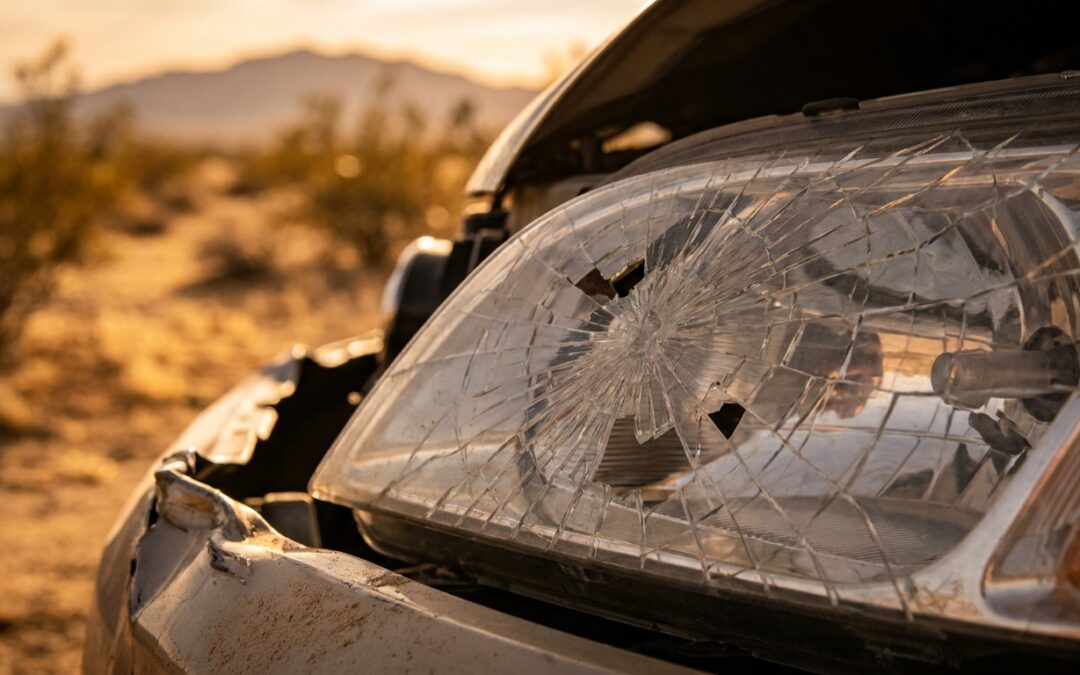
When that housing takes a hit, a few things can happen, sometimes all at once: the lens cracks or shatters, a mounting tab snaps so the whole unit sits crooked, the internal reflector or LED board shifts out of its aimed position, or the wiring connector gets pulled partway loose. None of those are cosmetic-only problems. A cracked lens lets in Arizona dust and monsoon moisture that fogs the inside of the housing within days. A shifted mount throws off the beam aim even if the lens looks fine. And on newer vehicles, a jarred housing can be enough to knock a forward-facing camera out of calibration even when the glass over the lens itself never cracked.
Halogen, LED, and Camera-Integrated Headlights: Why the Price Range Is So Wide
Part of why headlight replacement costs vary so much comes down to what’s actually inside the housing. A base-trim halogen headlight is a simple reflector, bulb socket, and lens — inexpensive to manufacture and inexpensive to replace. Move up to LED projector headlights and the part gets more complex: LED boards, heat sinks, and sometimes an auto-leveling motor that keeps the beam angle correct as the car’s weight shifts under braking or load.
The top of the range is the camera-integrated assembly found on many newer trucks, SUVs, and sedans with adaptive cruise, lane-keep assist, or automatic high-beam features. On these vehicles, the forward-facing camera that feeds those systems is sometimes mounted in or near the headlight housing rather than behind the windshield, and the headlight itself may include matrix LED elements that selectively dim individual segments of the beam to avoid blinding oncoming traffic. Replace one of these and you’re not just swapping a lens — you’re replacing a sensor-adjacent electronic component that has to be aimed and, in many cases, calibrated with scan tool software before the driver-assist features work correctly again.
This is also why two owners of the “same car” can get very different quotes. A base trim and a top trim of the identical model year frequently use completely different headlight assemblies, and only one of them needs the extra calibration step.
Common Accident Scenarios That Damage Headlights
We see a handful of patterns come through the shop repeatedly:
- Parking lot taps and backing incidents. Low-speed, but often enough to crack a lens or snap a plastic mounting tab, especially on vehicles where the headlight sits low and forward.
- Front-end collisions at an intersection. The most common cause of serious headlight damage, frequently paired with bumper, fender, and sometimes radiator support damage. See our front-end collision damage guide for the bigger picture.
- Being rear-ended hard enough to push your car into something ahead. The headlight damage shows up on the front of your car even though the original hit was from behind.
- Animal strikes on East Valley roads at dusk. A deer, coyote, or stray animal in the road can crack a headlight housing without necessarily causing major body damage, which sometimes leads owners to underestimate what needs fixing.
- Hood or latch damage that doesn’t fully explain itself until the car is on the lift. If a hood won’t latch properly or sits unevenly after a hit, the headlight housing on that side is worth a close look even if it looks intact from the driver’s seat.
How Network Collision Handles a Headlight Replacement
We don’t sublet headlight work to a glass shop or an electrical specialist — it’s done on-site as part of the same repair as any other front-end damage, which keeps the car moving through one shop instead of two.
1. Diagnose What’s Actually Damaged
We inspect the housing, mounting tabs, wiring connector, and any adjacent bumper or fender damage before ordering parts. Sometimes a cracked lens with an intact housing and connector can be addressed without replacing the full assembly; more often, the impact that cracked the lens also broke a mounting point, and the assembly has to come out.
2. Source the Right Part
We quote both OEM and quality aftermarket headlight assemblies and explain the difference in fit, beam pattern, and any integrated sensors before you decide. If your policy or state disclosure rules require us to note aftermarket parts on the estimate, we do that in writing.
3. Install, Aim, and Calibrate
Every replaced headlight gets its beam pattern aimed before the car leaves. On vehicles where the housing integrates a camera or sensor tied to a driver-assist feature, that component gets recalibrated as part of the same visit — not scheduled as a separate trip to a dealer.
Signs You Need a Full Headlight Replacement, Not Just a Bulb
- The lens is cracked, shattered, or has a visible hole after the impact
- Moisture or fogging has appeared inside the housing since the collision
- The headlight sits noticeably crooked or sunken compared to the other side
- A mounting tab or bracket is visibly snapped
- Auto high-beam, cornering lights, or adaptive lighting stopped working correctly
- A dash warning light for headlights or driver-assist systems appeared after the hit
Not Sure if It’s a Bulb or a Full Assembly?
Send us a photo of the damage and we’ll give you a straight answer before you spend a dollar.
2026 Headlight Replacement Cost Ranges (East Valley)
Costs vary widely by vehicle and trim, since a base halogen headlight and a camera-integrated LED matrix headlight on the same model can be priced hundreds of dollars apart. Here’s the honest range we see.
| What’s Needed | Typical 2026 Cost (Installed) |
|---|---|
| Bulb or LED module only (housing undamaged) | $100 – $300 |
| Aftermarket headlight assembly (standard halogen models) | $250 – $600 |
| OEM headlight assembly (no integrated camera/sensor) | $500 – $1,100 |
| OEM headlight assembly with integrated camera/sensor (ADAS trims) | $900 – $2,200 |
| Aiming or calibration only (housing already replaced elsewhere) | $150 – $350 |
If the collision also damaged the bumper or fender around the headlight, that’s priced separately and usually falls in our standard front-end collision repair range. We’ll always give you one combined written estimate rather than splitting it into confusing line items.
DIY Headlight Replacement: When It’s Fine and When It’s Not
Plenty of people replace a burned-out bulb themselves, and that’s genuinely fine on vehicles where the bulb is a separate serviceable part. Where DIY gets risky is after a collision, for three reasons. First, a plastic housing with a snapped mounting tab can look like it’s seated correctly while sitting slightly crooked, which throws off your beam aim in a way that’s hard to judge by eye at night. Second, sourcing the correct part number for your specific trim is easy to get wrong — the wrong headlight can physically bolt in but have the wrong connector, beam pattern, or missing sensor housing. Third, and most overlooked, swapping a camera-integrated headlight without recalibrating the camera can leave a driver-assist feature silently working off a slightly wrong reference point, which isn’t something you’ll notice until the system behaves oddly on the road.
If your car is a simple non-sensor model and the housing truly is undamaged with just a dead bulb, a DIY swap is reasonable. If a collision was involved at all, it’s worth at least a quick inspection before you order parts.
How Insurance Handles Headlight Replacement
If the accident wasn’t your fault, the at-fault driver’s insurance should cover the full cost of a correct repair, including aiming or calibration. If you’re using your own collision coverage, your deductible applies but the process is the same. Either way, we write the estimate, work directly with the adjuster on the scope, and make sure calibration isn’t quietly left off the estimate — it’s a real line item, not an optional extra, when the housing integrates a sensor.
Arizona law gives you the right to choose your own repair shop regardless of which shop your insurer suggests. We’re an independent shop, not on anyone’s direct repair program, so our estimate reflects what your car actually needs rather than a negotiated template. More on that here: insurance claim help.
One detail worth watching for: many state disclosure rules require a shop to note on your estimate when a part is aftermarket rather than factory OEM. That’s useful information, not a red flag by itself — quality aftermarket headlight assemblies exist and can be a reasonable choice, particularly on older vehicles. The disclosure just means you get to make that call with full information instead of discovering it later. If an estimate you’ve received doesn’t mention OEM versus aftermarket at all for a headlight line item, it’s a fair question to ask before you approve the repair.
If calibration is needed and gets left off an estimate, that’s the more common oversight we see when a car has already been quoted elsewhere. A headlight that looks correctly installed but was never recalibrated can leave a camera-dependent safety feature operating on bad data, which is why we treat calibration as its own line item rather than folding it into a vague “installation” charge.
↓ Worried There’s More Hidden Damage?
A cracked headlight after a harder hit can be a sign of damage further back — a bent radiator support or shifted frame rail hiding behind the bumper. Tell us what happened and we’ll let you know what to check.
If the impact was hard enough to crack the headlight housing itself rather than just the lens, it’s worth having the front structure checked. Our structural damage inspection and frame damage guides cover what hidden damage can look like weeks after a crash that seemed minor at the time.
Headlight Replacement FAQ — Gilbert, AZ
Can I just replace the bulb instead of the whole headlight assembly?
Only if the housing, lens, and connector are undamaged and the bulb itself failed on its own. After a collision, the impact almost always affects the housing or a mounting point, which means the bulb isn’t the real problem.
Does insurance cover headlight replacement after an accident?
Yes, when it’s the result of a covered collision. The at-fault driver’s liability coverage or your own collision coverage should pay for the assembly, labor, and any required aiming or calibration, minus your deductible if you’re using your own policy.
Do I need calibration after a headlight replacement?
If the housing includes a forward-facing camera, auto-leveling sensor, or adaptive lighting module, yes. Even without a camera, every replaced headlight should have its beam aim checked and adjusted before the car leaves the shop.
Can I choose OEM parts instead of aftermarket for my headlight?
In most cases, yes. We’ll quote both OEM and quality aftermarket options and explain the difference in fit and features so you can decide, and we’ll note the choice on your written estimate for your insurer.
Is it safe to drive with a cracked headlight?
Short distances during the day are generally fine, but a cracked lens lets in moisture that fogs the housing and can damage the bulb or wiring over time. Driving at night with a broken or misaimed headlight is a real visibility and legal risk, so it’s worth getting looked at quickly.
How long does headlight replacement take?
A straightforward assembly swap with aiming is often a same-day or next-day job once the part is in stock. Camera-integrated assemblies that need calibration, or cases where the bumper also has to come off, typically add a day.
Does a cracked headlight mean there’s more hidden damage?
Not always, but a harder impact that cracks the housing rather than just chips the lens can also affect the radiator support or frame rail behind it. We check that as part of any headlight repair rather than just swapping the part and sending you home.
Why do two of the same car model get such different headlight repair quotes?
Trim level. The base trim of a model often uses a simple halogen or basic LED headlight, while a higher trim on the identical model year can use a camera-integrated matrix LED assembly that costs several times more and requires calibration. The part number, not just the make and model, determines the price.
Can I drive to get an estimate with a cracked headlight, or should I tow it?
If the car is otherwise driveable and the damage is limited to the headlight and surrounding trim, driving it in during daylight is normally fine. If the hood won’t close, fluids are leaking, or there’s visible frame or radiator support damage, it’s safer to have it towed in so we can look at everything at once.
Get It Fixed Right the First Time
Whether it’s a cracked lens or a full assembly with a camera behind it, we’ll tell you honestly what your car needs and handle the aiming, calibration, and insurance paperwork in-house.
Or call us directly at (480) 691-2299 · 1021 N Gilbert Rd Unit 105, Gilbert, AZ 85234
Related reading: Front-End Collision Damage Repair · Frame Damage Repair · Structural Damage Inspection · Insurance Claim Help · Auto Body Shop Gilbert AZ · All Services