
Door Ding Repair Gilbert AZ: 2026 Guide (5 Signs)
You come out of Target, SanTan Village, or the grocery store and there it is: a shallow, dime-sized crease in your door from someone else’s door handle or a shopping cart. Most parking lot door dings are fixable without a drop of paint — but not all of them. The honest answer depends on whether the paint and clear coat over that crease are still intact, and that’s a closer look than most drivers give it before deciding what to do next. Here’s how to tell the difference, what each repair path actually costs, and why having both options under one roof matters.
Network Collision Repair is a family-owned body shop on Gilbert Road, repairing East Valley vehicles since 1995. We see door dings from Gilbert, Mesa, Chandler, and Queen Creek parking lots every week, and the first thing our estimators do is figure out which of two repair paths your particular ding actually needs — because guessing wrong wastes your money either way.
Not Sure If Your Door Ding Needs Paint?
Send us a photo or swing by. We’ll tell you straight whether it’s a paintless dent job or a paint-matched repair, and give you a written estimate either way.
What a Door Ding Really Is
A “door ding” is panel damage from a low-energy impact: another car’s door edge, a shopping cart corner, a bike pedal, a wayward golf cart in a dealership lot. The metal (or in some newer vehicles, the composite panel) stretches and creases inward, but there’s usually no tearing and no structural involvement — it’s cosmetic, localized, and shallow. That’s what makes it different from a fender bender: there’s no bumper, no bracket, nothing bent underneath. It’s purely a panel-skin problem.
The question that actually determines your repair path isn’t how big the dent looks. It’s whether the paint film over the crease is still unbroken.
Paintless Dent Repair (PDR): When It Works
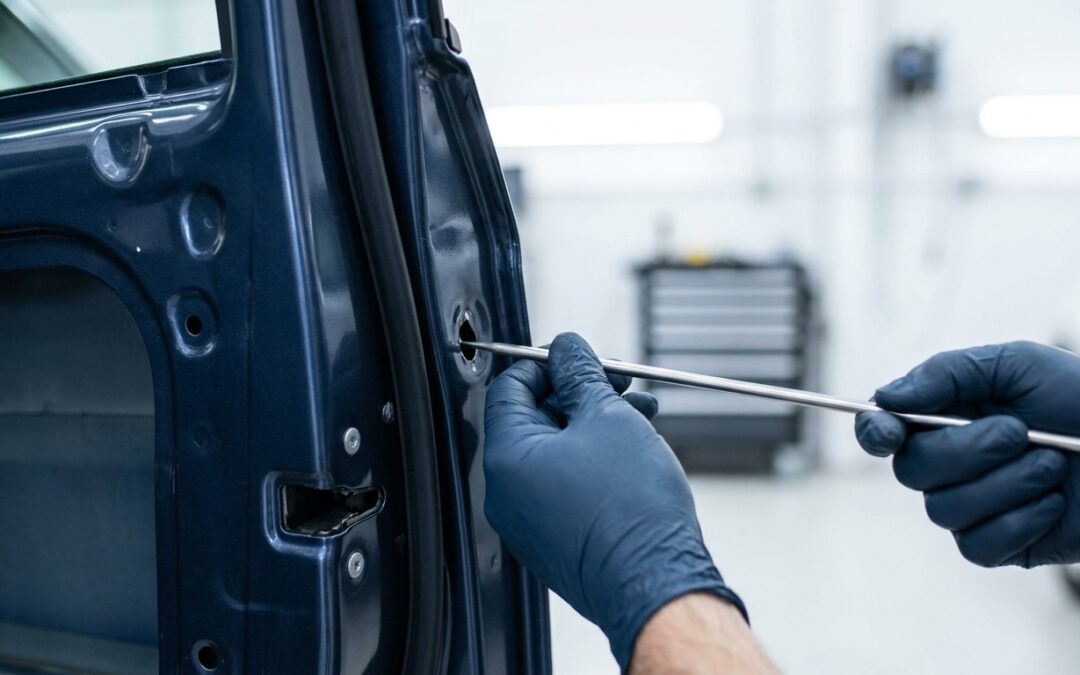
Paintless dent repair uses specialized rods, picks, and glue-pull tabs to massage the metal back to its original shape from behind the panel, without ever opening a can of paint. It works because factory clear coat and base coat have some flexibility — up to a point, they can stretch back out with the metal instead of cracking.
PDR is the right call when all of the following are true:
- The paint surface is smooth to the touch across the whole dent, with no roughness or texture change
- There’s no visible cracking, chipping, or flaking in or around the crease
- The metal isn’t creased sharply enough to have stressed the paint past its limit
- The dent isn’t right on a body line, edge, or crease fold (those areas are much harder to access with PDR tools and more likely to have cracked paint anyway)
Done well, PDR is the best possible outcome for a door ding: no paint booth time, no risk of a color mismatch, and a panel that’s structurally and cosmetically back to original. It’s also why a lot of generic “dent repair” marketing assumes every ding qualifies. A meaningful share don’t.
The 5 Signs Your Door Ding Needs Paint, Not Just PDR
Look Closely Before You Decide
- You can see or feel a crack in the clear coat. Run a fingernail lightly across the dent in good light. A hairline crack means the paint film has already failed, and PDR alone will leave that crack behind.
- There’s chipped or missing paint down to primer or bare metal. Any white, gray, or silver showing through at the deepest point of the dent means the impact broke through the finish.
- The dent sits on a sharp body line or panel edge. Paint over a crease fold is under more stress than paint on a flat panel, and it’s also where PDR tools have the least room to work from behind.
- The impact left a scuff, scratch, or transfer mark (paint or rubber from whatever hit you) along with the dent. Scuffed clear coat usually needs to be color-sanded or refinished even if the dent itself could be massaged out.
- The dent is sharp-edged or has a pointed low spot rather than a smooth, rounded depression. Sharp creases are more likely to have already overstressed and cracked the paint, even if it’s not obvious yet.
If any one of these is true, the honest move is a paint-matched body repair: light filler work on the crease, primer, color-matched basecoat, and clearcoat blended into the surrounding panel so the repair is invisible. If none are true, PDR gets you back to original for less money and less time in the shop.
DIY Door Ding Fixes: What Actually Works (and What Doesn’t)
The internet is full of hot water, hair dryer, plunger, and dry ice tricks for popping out a door ding at home. Worth knowing before you try one:
- The plunger/suction method can work on shallow, rounded dents on a flat panel with intact paint — it’s a crude version of the same principle PDR uses (pulling the metal back out), just without the control or access of a proper glue-pull kit. It almost never works on sharp creases or anything near a body line.
- Hot water plus cold air (or dry ice) relies on the metal expanding and contracting to pop back into shape. It occasionally helps on very shallow, round dents, but it’s unpredictable, and pouring near-boiling water on paint that already has a hairline crack can make that crack worse, not better.
- Hair dryer and compressed air duster tricks are mostly internet myth for anything beyond the shallowest dings. They rarely generate enough of a temperature swing to move the metal.
- Pushing on the dent from inside the door (reaching through a speaker cutout or access panel) is roughly what a PDR technician does, minus the rods, picks, and reflection board that let a trained tech control exactly how much the metal moves. Overcorrect by hand and you can push the panel out past flat, which then needs professional correction anyway.
The real risk with DIY attempts isn’t wasting an afternoon — it’s turning a clean PDR candidate into a paint job. If the paint was intact before you tried a home fix and it cracks during the attempt (common with the hot water method on anything but the shallowest dings), you’ve converted a $75–$500 repair into a $400–$900 one. If you’re not confident the paint is fully intact and the dent is shallow and round, it costs nothing to have us take a look first.
Already Got a PDR Quote That Didn’t Add Up?
If a mobile PDR tech told you a cracked-paint ding was a simple pop-out, bring it to us for a second look. We’ll tell you what it actually needs.
How Network Collision Handles a Door Ding
Every door ding starts the same way: a close inspection under good light (and sometimes a paint depth gauge) to check for cracking, chipping, and whether the dent sits on a stress point. That inspection is what decides your repair path, not a guess from across the parking lot.
If it’s a PDR job: our technician accesses the panel from behind (through the door’s existing service openings wherever possible, without unnecessary disassembly) and works the metal back out with rods and glue-pull tools until the panel reads flat under a reflection board. No paint, no booth time, same-day in most cases.
If it needs paint: the panel gets light filler work if needed, then primed, and color-matched using a digital spectrophotometer that reads your vehicle’s actual aged paint rather than just a factory code off a sticker. Arizona sun fades paint unevenly over time, so a 2019 car and a 2024 car in the same factory color are rarely an exact match off the shelf anymore. We blend the new paint into the adjacent panel edges so there’s no visible line where old meets new. More on how we handle color matching on our paint matching page.
Because both processes happen in the same shop, you’re not getting bounced between a mobile PDR vendor and a separate body shop if the inspection reveals you need paint after all. One estimate, one appointment, one warranty.
What It Costs
Door ding repair costs vary with size, location on the panel, and whether paint is involved. Here’s the honest range for 2026:
| Repair Type | Typical 2026 Range |
|---|---|
| Paintless dent repair (paint intact) | $75 – $500 |
| Panel refinish (paint cracked or chipped, filler + paint blend) | $400 – $900 |
PDR pricing scales with the dent’s size and how accessible the panel is from behind (some door designs have more internal bracing and service openings than others, which affects labor time). Paint repairs scale with how much blending is needed to disappear the repair into surrounding panels. We give you a written number after the inspection, not a phone-quote guess.
Is It Worth Filing an Insurance Claim?
For most single door dings, the repair cost is close to or under a typical comprehensive deductible, which means filing a claim may not make financial sense — you’d pay the deductible anyway and the claim shows up on your record. That said, if the ding is part of a larger incident (a hit-and-run, a shopping cart that also damaged a mirror or adjacent panel, or multiple dings from the same event), it’s worth a conversation with your adjuster. Arizona drivers have the right to choose their own repair shop for any claim, regardless of which shop an insurer suggests. More on that right and how claims actually move on our insurance claim help page.
↓ Want an Honest Read on Your Ding Before You Decide?
Send us a couple of photos in direct sunlight (that’s when cracked clear coat actually shows up). We’ll tell you which repair path it needs and what it’ll cost, no obligation.
Why Choose Network Collision for a Door Ding
Plenty of mobile PDR operators will come to your driveway and pop out a dent in your garage. That’s fine when the ding genuinely qualifies for PDR. The problem is most of them have no paint booth to fall back on, so a dent with cracked paint either gets “fixed” with the crack left behind, or you get sent somewhere else entirely for the paint work — a second vendor, a second appointment, a second invoice.
Network Collision Repair is a family-owned, all-makes shop, not a dealer collision center and not a single insurer’s preferred vendor. We’ve been doing both dent work and color-matched paint repair in the East Valley since 1995, which means whichever path your ding actually needs, you’re not getting routed to a different business to finish the job. One shop, one warranty, one phone number if anything about the repair ever needs a second look. If your ding turns out to be more involved than it looked (a crease that goes deeper than expected, or a scuff that needs more blending than a single panel), you’ll find that out from the same people doing the work, not a second business bidding on the leftover job. For broader cosmetic damage beyond a single ding, see our scratch and paint damage page; for hail-related dents specifically, see our hail damage repair page, which covers the same PDR-vs-paint decision at a larger scale.
Door Ding Repair FAQ — Gilbert, AZ
Can every door ding be fixed without paint?
No. Paintless dent repair only works when the paint and clear coat over the dent are still intact and flexible enough to be massaged back into shape. If the paint has cracked, chipped, or the dent sits on a sharp body line, PDR alone will leave a crack or a flat spot behind. An inspection under good light tells you which category your ding falls into.
How do I check my own door ding before bringing it in?
Look at it in direct sunlight, not shade or garage lighting, and run a fingernail lightly across the crease. Hairline cracks and chips are much easier to spot in harsh sun. If you see or feel any break in the paint surface, assume it needs a paint-matched repair rather than PDR.
Will a repainted door panel match the rest of my car?
It should, if the shop uses a spectrophotometer to read your car’s actual current paint (which fades unevenly in Arizona’s sun over time) rather than just pulling a factory code off the door jamb sticker. We blend new paint into the surrounding panel edges so there’s no visible seam. See our paint matching page for more on how that process works.
Does insurance cover door ding repair?
Comprehensive coverage typically applies to parking lot dings, but most single-ding repairs cost less than or close to a typical deductible, so many drivers pay out of pocket rather than file a claim. If the ding is part of a larger incident or you’re unsure, we can walk you through the math before you decide.
How long does door ding repair take?
A straightforward PDR job is often same-day. A paint-matched repair needs time for filler cure, primer, paint, and clear coat to properly flash and cure between stages, which usually runs a few days depending on shop schedule and how much blending the color match requires.
Can a door ding lead to rust later?
Yes, if the paint is cracked or chipped and left unrepaired. Arizona’s climate is dry, but any break in the paint film that exposes bare metal is a path for moisture (even just monsoon humidity) to start corrosion underneath the finish. That’s one more reason not to assume a cracked-paint ding will be fine if you just leave it.
Do you repair door dings on all makes and models?
Yes. We’re a family-owned, all-makes shop, not tied to a single brand or dealer network. We handle the panel access and paint systems for everything from economy sedans to trucks and SUVs.
Do you serve Mesa, Chandler, and Queen Creek for dent repair?
Yes. Network Collision Repair is located at 1021 N Gilbert Rd Unit 105, Gilbert, AZ 85234, and serves drivers across the East Valley.
Get an Honest Read on Your Door Ding
Whether it’s a clean pop-out or a paint-matched repair, we’ll tell you which one you actually need and give you a written number before any work starts.
Or call us directly at (480) 691-2299 · 1021 N Gilbert Rd Unit 105, Gilbert, AZ 85234
Related reading: Hail Damage Repair · Car Scratch Repair · Car Paint Matching · Insurance Claim Help · Post-Repair Inspection