
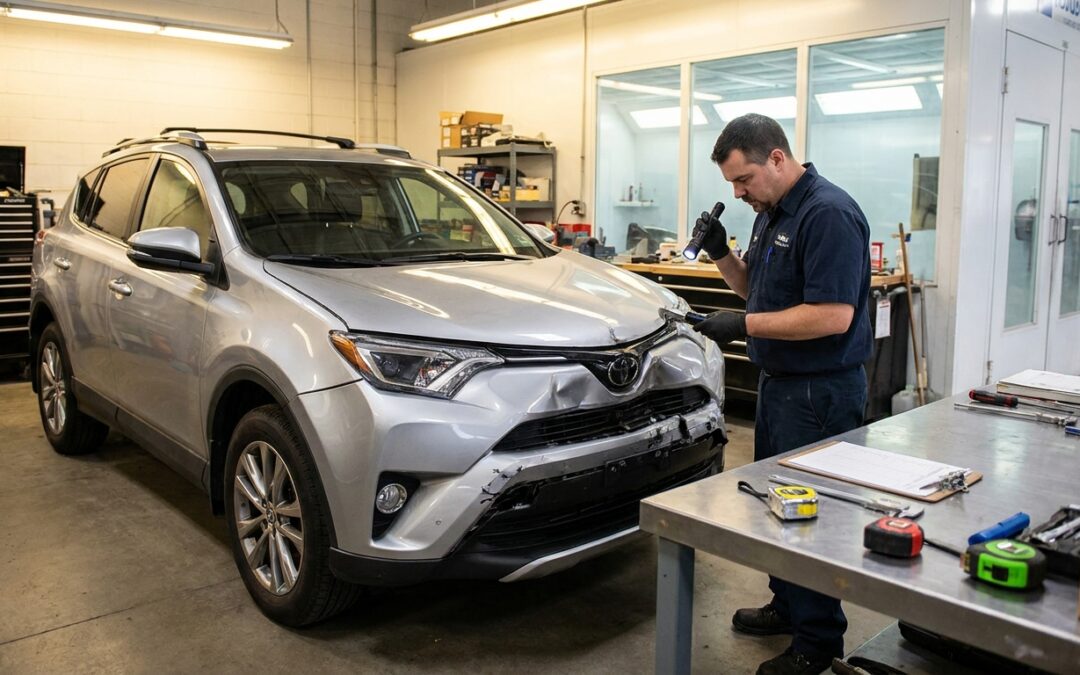
Toyota Collision Repair in Gilbert, AZ: A 2026 Guide From a Shop With 31 Years in the East Valley
Toyota is the best-selling brand on Arizona roads, which means Toyota collision repair is one of the most common jobs we see at our Gilbert Road shop — a Camry with a crumpled rear bumper after a parking lot fender-bender, a RAV4 that needs a fender replaced after a monsoon dust-storm pileup, or a Tacoma with front-end damage after a freeway merge. The question isn’t just “who can fix my car” — it’s “who can fix my Toyota correctly, with paint that matches and safety systems that still work.” Network Collision Repair is a family-owned, all-makes collision shop on Gilbert Road that has been repairing East Valley vehicles — Toyotas included — for 31 years. This guide covers what Toyota collision repair actually involves, how we handle it, and what it costs in 2026.
We want to be upfront about something before we go further: we are not a Toyota-certified dealership body shop. We’re a family-owned, all-makes collision repair shop that has been fixing Camrys, Corollas, RAV4s, Highlanders, Tacomas, Tundras, 4Runners, and Siennas on East Valley roads since 1995, back when the shop was part of Network Automotive. If you need dealership-level OEM certification for a specific warranty situation, we’ll tell you that plainly. For the vast majority of collision, dent, and paint work Toyota owners actually need, an experienced independent shop with the right equipment gets the job done well, usually faster, and often for less.
Get a Free Estimate on Your Toyota Repair
Send us photos of the damage or bring your Toyota by our Gilbert Road shop. We’ll give you a written estimate with no pressure and no obligation.
What Toyota Collision Repair Actually Involves
Collision repair on a Toyota isn’t fundamentally different from collision repair on any other modern vehicle — but there are a few things specific to the brand and its recent model lineup that matter once you’re past a simple scuff.
Paint Codes and Color Match
Every Toyota has a paint code on a sticker inside the driver’s door jamb, usually alongside the tire pressure placard. That code tells a shop which base color to mix — but it doesn’t account for how your specific car’s paint has aged and faded in the Arizona sun over the last several years. A 2020 RAV4 in Magnetic Gray Metallic and a brand-new RAV4 in the same factory color are no longer really the same color once one of them has spent five summers in a parking lot. That’s why color matching modern Toyota paint — whether it’s Super White, Blueprint, or Celestite Gray Metallic — takes a digital spectrophotometer reading of your actual panel, not just a lookup of the factory code. More on how we handle paint matching here.
Toyota Safety Sense Cameras and Radar
Nearly every Toyota built in the last several years — Camry, Corolla, RAV4, Highlander, Tacoma, and Sienna — comes equipped with Toyota Safety Sense, a suite of driver-assist features that includes pre-collision braking, lane departure alert, and dynamic radar cruise control. Those features rely on a forward-facing camera mounted near the rearview mirror and a millimeter-wave radar unit built into the front grille or bumper fascia. When a bumper is removed and replaced — which happens in the majority of front-end collision repairs — that radar has to be recalibrated using the correct procedure before the safety systems can be trusted again. Skipping this step is one of the most common defects found in body shop comebacks. More on ADAS calibration here.
Aluminum and High-Strength Steel Panels
Some newer Toyota hoods and body panels — including certain RAV4 and Tacoma trims — use aluminum or high-strength steel in places older Toyotas didn’t. Aluminum can’t be repaired with the same tools or welded the same way as steel — it requires separate, dedicated equipment to avoid contaminating the metal or compromising its strength. A shop that treats every panel the same way, regardless of what it’s made of, is a shop that’s guessing.
Airbags and Restraint System Resets
Any collision severe enough to deploy an airbag also triggers seatbelt pretensioners and, in many cases, a restraint control module (SRS unit) that needs to be reset or replaced entirely per the manufacturer’s procedure. This isn’t optional and it isn’t cosmetic — it’s the difference between a restraint system that works correctly in a future accident and one that doesn’t. Any estimate that skips this step on a vehicle with airbag deployment is an estimate to be suspicious of.
Common Ways Toyotas Get Damaged Around Gilbert
Damage patterns here are shaped by East Valley driving conditions as much as anything else. A few things we see repeatedly:
- Parking lot door dings and shopping cart strikes at busy retail corridors along Val Vista, Gilbert Road, and the SanTan Village area — usually a PDR or bumper cosmetic repair on a Camry or Corolla.
- Monsoon hail damage on hoods, roofs, and trunk lids during the July-September storm season, especially on RAV4 and Highlander roof panels — often paintless dent repair if the paint surface isn’t broken.
- Rear-end collisions in freeway merge traffic on the 202 and 60, which frequently involve bumper, fascia, and sometimes trunk or liftgate damage.
- Intersection collisions at high-volume East Valley intersections, which tend to produce more significant front or side structural damage requiring frame measurement.
How Network Collision Repairs Toyotas
Here’s what actually happens when a Toyota comes into our Gilbert Road shop, and what we have in-house to handle it.
Electronic Frame Measuring
For anything beyond cosmetic damage, we put the vehicle on our electronic frame measuring system to check it against factory tolerances. This catches hidden structural damage that isn’t visible from the outside — something that matters more than most drivers realize, since a frame that’s out of spec by even a small amount can affect how the car handles and how safety systems perform later.
In-House, Climate-Controlled Paint Booth
We paint every Toyota in-house in a climate-controlled downdraft booth using PPG and Axalta paint systems, color matched with a spectrophotometer on every refinish job. We don’t sublet paint work to a third party, which means the same team that disassembles your car is accountable for how it looks when it’s reassembled.
ADAS Recalibration In-House
When a repair involves a bumper, windshield, or any panel that houses a camera or radar sensor, we handle the Toyota Safety Sense recalibration in-house as part of the repair — not as an afterthought or a sublet step that adds another week to your timeline.
I-CAR Trained Technicians
Our technicians carry I-CAR training, the industry-standard collision repair credential, and have collectively repaired thousands of vehicles across every major make on East Valley roads. We’re not claiming Toyota-specific factory certification — we’re telling you honestly that our technicians have deep, current experience with the platforms Toyota actually sells here: Camry, Corolla, RAV4, Highlander, Tacoma, Tundra, 4Runner, and Sienna.
Toyota Models We Repair Most Often in the East Valley
Toyota sells the highest-volume lineup on Arizona roads, and it shows in our shop after fender-benders, hail, and parking lot dings around Gilbert, Mesa, Chandler, and Tempe. Here’s the rough breakdown of what we see and what tends to need attention on each.
| Toyota Model | What We Commonly See |
|---|---|
| Camry / Corolla | Front and rear bumper damage, door dings, parking lot scrapes |
| RAV4 / Highlander | Bumper and fender damage with Toyota Safety Sense recalibration needed |
| 4Runner | Larger panel replacement, quarter panel and liftgate damage |
| Tacoma / Tundra | Bed and tailgate damage, front-end collision repair; see our truck collision repair guide for pickup-specific notes |
| Sienna | Sliding door and rear quarter panel damage, hail dents on the large roof panel |
Already Have a Repair Quote for Your Toyota?
Bring it in and we’ll give you a written second-opinion estimate so you can compare line items side by side, at no cost.
What Toyota Collision Repair Costs in 2026
Every repair is different, but here are honest, current ranges based on what we actually see and charge on Toyota vehicles in the East Valley. These are starting-point ranges, not quotes — the only way to get an accurate number is a written estimate on your specific vehicle and damage.
| Repair Type | Typical 2026 Range |
|---|---|
| Paintless dent repair (PDR) | $75 – $500 |
| Bumper repair or replacement | $150 – $1,800 |
| Single panel refinish | $400 – $900 |
| Frame / structural repair | $1,200 – $14,000 |
Where a Toyota repair tends to land toward the higher end of the bumper or panel range is when Toyota Safety Sense recalibration is part of the job — that’s a real, necessary line item on many newer RAV4, Camry, and Highlander repairs, and any written estimate we give you will show it separately rather than burying it. If your repair is being paid through insurance, our insurance claim help guide walks through how that process works and what your rights are as the vehicle owner in Arizona.
Why East Valley Toyota Owners Choose Network Collision
We’ve been on Gilbert Road since 1995, as part of Network Automotive before becoming a standalone collision shop. That’s 31 years of repairing vehicles for the same community, which means a few things in practice:
- We’re not going anywhere. Our lifetime workmanship warranty means something because we’ll still be here in five or ten years if you ever need us.
- We work directly with your insurance company and write supplements when the real scope of a repair exceeds what an insurer’s initial estimate assumes.
- We show you the shop. If you want to see the frame rack, the paint booth, or where your Toyota is in the repair process, you’re welcome to stop by.
- We give you a written, line-itemed estimate before any work starts — no verbal ballparking over the phone.
Questions to Ask Before You Choose a Toyota Repair Shop
- Do you have an electronic frame measuring system on-site?
- Do you paint in-house, and with what paint brand?
- Do you color match with a spectrophotometer?
- Do you perform Toyota Safety Sense recalibration in-house, or is it sublet?
- What’s your written workmanship warranty?
- Will you provide a line-itemed written estimate before starting work?
- Will you communicate directly with my insurance adjuster?
Ask any shop you’re considering these questions, including us. A shop that answers plainly and shows you the work in progress is a shop worth trusting with your Toyota.
↓ Want a Free Estimate on Your Toyota?
Send us a quick note with your year, model, and what happened — we’ll follow up with a written estimate and answer any questions about the repair process. No obligation.
Insurance Claims on a Toyota Repair
If your Toyota was damaged in an accident that wasn’t your fault, or you’re filing a claim through your own comprehensive or collision coverage, Arizona law (ARS §20-469) gives you the right to choose your own repair shop — regardless of which shop your insurer suggests. We work with all major insurers, communicate directly with your adjuster, and handle supplement requests when hidden damage — common with modern unibody construction — is found once the vehicle is disassembled.
If you’re unsure whether your Toyota should be repaired or whether the damage might total the vehicle, get a written estimate first. A clear scope of work from an independent shop is the best tool you have in that conversation, whether you’re negotiating with your insurer or deciding what’s worth fixing yourself.
One thing worth knowing: insurance estimating software often underestimates the true scope of a modern collision repair, especially when Toyota Safety Sense recalibration, hidden structural damage, or aluminum panel work is involved. That’s why we write supplements — additional line items backed by photos and documentation — when we find damage or required procedures the initial estimate missed. This is a normal, routine part of the repair process, not a red flag, and any shop that never writes supplements is either getting lucky or not looking closely enough.
Toyota Collision Repair FAQ — Gilbert, AZ
Is Network Collision Repair a Toyota-certified shop?
No. We’re an independent, family-owned, all-makes collision shop. We don’t claim Toyota factory certification, but our technicians have extensive, current experience repairing the Toyota models most common on East Valley roads, and we use OEM-quality repair procedures and I-CAR training as our standard.
Will my Toyota’s safety features work correctly after a bumper repair?
They should, as long as any camera or radar sensor disturbed during the repair is properly recalibrated. We handle Toyota Safety Sense recalibration in-house on models equipped with the system, and we test the calibration before returning the vehicle.
Can you match the paint on my Toyota exactly?
We use a digital spectrophotometer to read your car’s actual current paint color, not just the factory code, which accounts for sun fade and age. This is especially important in Arizona, where UV exposure fades paint faster than in most climates. More on our paint matching process here.
Do you work on the Toyota Tacoma or Tundra?
Yes. We repair Tacoma and Tundra pickups regularly, including bed, tailgate, and front-end collision damage. See our truck collision repair guide for more on pickup-specific repair considerations.
How much will my Toyota repair cost?
It depends entirely on the damage. Paintless dent repair typically runs $75-$500, bumper repair or replacement $150-$1,800, a single panel refinish $400-$900, and frame or structural repair $1,200-$14,000. The only way to get an accurate number is a written estimate on your specific vehicle.
Will you deal with my insurance company directly?
Yes. We communicate directly with your adjuster, provide documentation they need, and write supplements when the real repair scope is larger than the initial estimate. More on the insurance claim process here.
Do you serve areas outside Gilbert, like Mesa or Chandler?
Yes. Network Collision Repair is located at 1021 N Gilbert Rd Unit 105, Gilbert, AZ 85234, and we regularly repair vehicles for customers throughout Mesa, Chandler, Tempe, and Queen Creek.
Can I get a second opinion if I already have a repair estimate from another shop?
Yes, and we’d encourage it for anything beyond a minor repair. Bring your existing estimate and we’ll give you a written second opinion so you can compare line items directly.
What warranty do you offer on Toyota collision repairs?
We offer a lifetime workmanship warranty on body and paint work for as long as you own the vehicle, in writing. Since we’ve been on Gilbert Road since 1995, that warranty is backed by a shop that isn’t going anywhere.
My Toyota has hail damage but the paint isn’t broken — do I still need bodywork?
Not necessarily. If the paint surface is intact, paintless dent repair (PDR) can usually resolve hail dents without any painting at all, which is faster and less expensive than a traditional repair. We’ll inspect the panels and tell you honestly whether PDR will fully resolve the damage or whether some panels will need conventional repair and refinish.
Get Your Toyota Fixed Right the First Time
Whether it’s a scraped bumper on a Corolla or structural work on a RAV4 after a bigger accident, our Gilbert Road shop has been repairing Toyotas and every other make in the East Valley since 1995. Get a free, written estimate before you decide anything.
Or call us directly at (480) 691-2299 · 1021 N Gilbert Rd Unit 105, Gilbert, AZ 85234
Related reading: Auto Body Shop Gilbert AZ · Auto Paint Shop · ADAS Calibration · Honda Collision Repair · Insurance Claim Help · All Services