
Frame Repair in Gilbert, AZ: 2026 Prices, How Frame Damage Is Diagnosed, and Why It Matters for Safety
Frame damage is the kind of repair most body shops in Gilbert can’t actually do — they sublet it out. That’s how you end up with quotes 3 weeks longer than they need to be and a final product that’s only as good as the shop someone else picked for you. Network Collision Repair has a full frame measuring and straightening system on-site, and three generations of body techs who’ve been pulling unibody and full-frame vehicles back to OEM spec for 30 years. This guide covers what frame damage actually is, how it’s diagnosed, what proper repair costs in 2026, and how to tell when a shop is doing it right.
Network Collision Repair is a family-owned auto body shop on Gilbert Road serving Mesa, Chandler, Tempe, Queen Creek, and the entire East Valley. Frame and structural work is one of the highest-stakes repairs we do — because it’s the difference between your car’s safety systems working as designed in the next accident, or not.
Free Frame Damage Assessment
Bring it in. We’ll put it on our measuring system and tell you exactly what’s out of spec, what it’ll cost to fix, and whether it’s economical to repair.
What “Frame Damage” Actually Means in Modern Cars
The term “frame damage” gets used loosely. Technically, only body-on-frame vehicles (most trucks and big SUVs — F-150, Silverado, Tundra, Tahoe, Suburban, RAM, Wrangler) have a true frame — a ladder of welded steel rails that the body bolts onto.
Cars and crossovers (Camry, Civic, RAV4, CR-V, Tesla Model 3 / Y, BMW, Mercedes sedans) use a unibody construction where the “frame” is integrated into the body shell itself — the roof, floor, rails, A/B/C pillars, and crumple zones are all engineered as one structural unit. When you hear “frame damage” on a unibody car, what’s really meant is structural damage to the rails, apron, cradle, pillars, or floor.
Either way the principle is the same: the steel structure of your vehicle was engineered to absorb crash energy in a specific way, and once it’s bent, twisted, or pulled out of spec, it needs to be measured and returned to factory tolerances or it will never crash-protect you again the way it was designed to.
Signs Your Vehicle May Have Frame or Structural Damage
Some are obvious. Others sneak up on you weeks after an accident. Any of these — especially in combination — warrants a measurement.
- Car pulls to one side even after an alignment
- Visible misalignment of panels — uneven hood gap, doors that don’t close right, trunk that sits crooked
- Tires wearing unevenly within weeks of an alignment
- Vibration above 50 mph that wasn’t there before
- Insurance estimate mentions “structural,” “rail,” “apron,” or “unibody” — if those words appear, you have frame work in your repair
- Wind or road noise that wasn’t there before — often a sign of pillar or roof structural deformation
- Diagonal measurement “tape” test fails — measuring corner to corner on the underside shows different distances
- ADAS warnings — lane-keep, blind-spot, or adaptive cruise behaving oddly post-accident
How a Real Frame Repair Gets Diagnosed at Network Collision
Step 1: Visual Inspection + ADAS Scan
We pre-scan every vehicle that comes in for structural assessment so we know what warning codes and module faults are present before we touch anything. Hidden codes often point to internal structural damage that’s not visible from outside.
Step 2: Mount on the Frame Rack
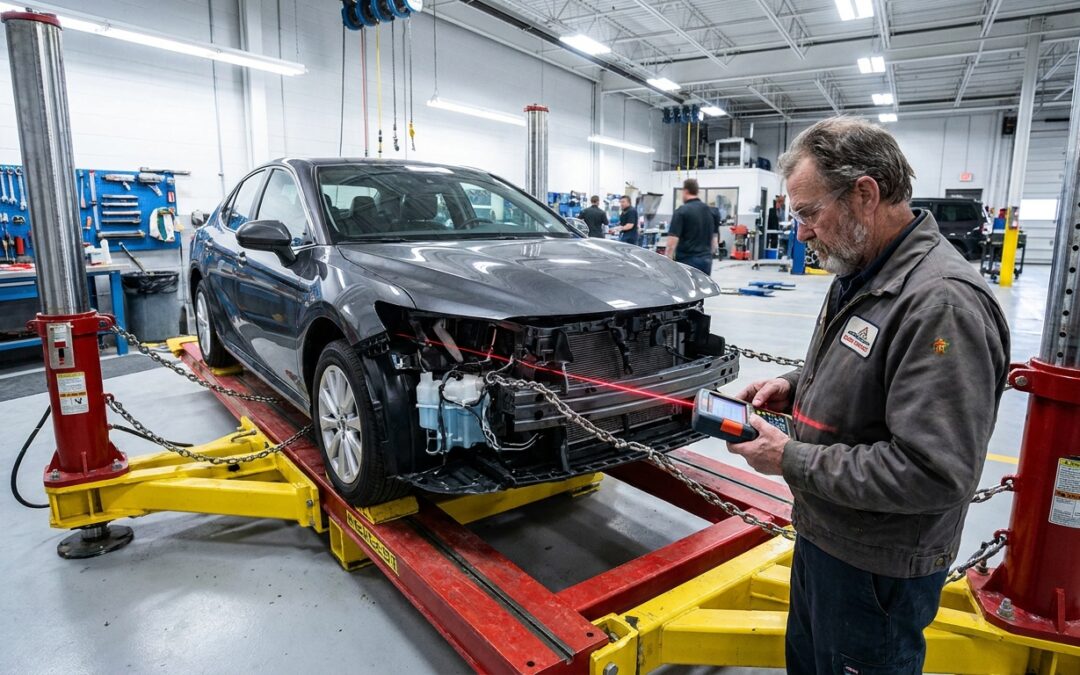
Vehicle goes onto our drive-on frame rack with the wheels chocked and the body secured. This locks the chassis in a controlled position so we can measure accurately.
Step 3: Electronic Measurement
Our electronic measuring system uses targets and sensors mounted at OEM-defined datum points (typically 30–60 points across the underside of the vehicle). Each point is compared to the manufacturer’s factory specifications stored in our software. Variances are reported in millimeters.
Step 4: Generate the Variance Report
The system prints a report showing every measurement vs. spec. Anything more than 3mm out of tolerance is flagged. This report goes into your file and is what we use to plan the pull.
Step 5: Plan the Pull Sequence
A frame pull is not one-and-done. We chain or strap the structure to hydraulic towers in a specific sequence, pulling each datum point back to OEM spec while heat-treating only where the metallurgy allows it. Steel has memory — pulling in the wrong order can lock in residual stress that makes future pulls impossible.
Step 6: Pull — Measure — Pull — Measure
We pull, release, re-measure. Pull, release, re-measure. Until every datum point is inside OEM tolerance. This is what separates a real frame shop from one that “straightens it until it looks right.” You can’t see 5mm with your eyes. The measuring system can.
Step 7: Replace Sectioned Structural Parts
If a rail, apron, or pillar is too far gone to pull (steel that’s been bent past its yield point can’t safely be straightened), we section in OEM replacement structural panels using factory weld procedures — MIG-brazing, squeeze-type resistance spot welding, and structural adhesives where the OEM specifies them. Wrong weld type in the wrong place = compromised crash performance.
Step 8: Final Measurement + Documentation
Last measurement after all pulls and replacements. Final report goes in your file. You get a copy. So does your insurance company.
Step 9: Alignment + ADAS Recalibration
Structural work moves suspension mounting points by definition. Four-wheel alignment is mandatory after every frame repair. ADAS cameras and radar are also re-calibrated because the sensor mounts moved.
Insurance Adjuster Says “Frame Damage”?
Don’t accept the first quote. Bring the estimate to us — we’ll measure the vehicle, give you a real diagnosis, and tell you whether the estimate covers the actual scope of work.
Frame Repair Costs in Gilbert, AZ (2026)
| Type of Damage | Typical 2026 Cost | Time in Shop |
|---|---|---|
| Minor pull (single rail, <10mm) | $1,200 – $2,200 | 2–4 days |
| Moderate unibody pull (front-end collision) | $2,500 – $5,000 | 5–8 days |
| Severe pull + sectioned rail / apron | $4,500 – $8,500 | 8–14 days |
| Full structural replacement (rail + pillar) | $7,500 – $14,000 | 2–4 weeks |
| Body-on-frame straightening (truck/SUV) | $1,800 – $4,500 | 3–7 days |
These ranges assume the work is being done in a properly equipped shop with measuring equipment and certified welders. Beware shops that quote frame repair without measuring the vehicle — you’re paying for guesses.
When Frame Repair Is “Totaled” vs. Worth Fixing
Insurance companies will declare a vehicle a total loss when the cost to repair exceeds a threshold of pre-loss market value (in Arizona, typically 70–80% of ACV). On older vehicles or severely-damaged newer ones, frame repair quickly crosses that line.
But that doesn’t automatically mean you have to take the totaled payout. Options:
- Take the payout and walk away. Insurance keeps the salvage.
- Take the payout and buy back the salvage for a reduced amount, then repair it on your own. Vehicle becomes a salvage title.
- Negotiate the ACV if you believe the pre-loss value is too low. Our Arizona DV guide walks through how to push back on lowball valuations.
We’ll honestly tell you when a vehicle isn’t worth repairing structurally. A 2014 Civic with a $9,000 frame quote isn’t economical. A 2022 Lexus is a different story.
Why Frame Repair Quality Matters for Safety
Cars are engineered to crash a specific way. The crumple zones deform, the rails redirect energy under the passenger compartment, the airbags fire at calibrated decelerations. When the structure is out of spec, every one of those systems gets confused.
A vehicle with a 6mm rail variance might pull slightly under braking and feel fine on the freeway — but in the next 35-mph collision, the engineered crumple sequence collapses in a different direction than designed. That changes airbag timing, seatbelt pretensioner behavior, and how much energy reaches the cabin.
This is why post-repair inspection after a frame repair is one of the highest-value things you can buy — ideally from an independent shop that didn’t do the original work.
↓ Free Frame Damage Phone Consult
Tell us what happened, what the insurance estimate says, and we’ll honestly tell you whether the quoted scope makes sense and whether your shop is set up to do it. No obligation.
Why Choose Network Collision Repair for Frame Work
- Frame measuring + straightening system on-site. We don’t sublet structural work.
- 30 years of frame and unibody repair experience across modern and classic vehicles.
- I-CAR trained, OEM weld procedures. Squeeze-type resistance spot welding, MIG-brazing, structural adhesives applied per manufacturer specs.
- Documentation included. You get the variance report and the measurement printouts in your file.
- ADAS recalibration on-site after every structural repair.
- Lifetime workmanship warranty on the structural pull.
- Family-owned, East Valley local. Read about us on the About page.
What to Bring to Your Frame Repair Appointment
- The vehicle
- Insurance claim number + adjuster contact (if it’s a covered loss)
- Original estimate / supplements (if you have them)
- Photos of the damage at the scene if you took any
- Police report if applicable
- Service records (helpful for pre-loss valuation if a total-loss negotiation comes up)
Frame Repair FAQ — Gilbert, AZ
How much does frame repair cost in Gilbert AZ?
2026 East Valley pricing: $1,200–$2,200 for a minor pull, $2,500–$5,000 for a moderate unibody pull after a front-end collision, $4,500–$8,500 for severe pulls including sectioned rails or aprons, and $7,500–$14,000 for full structural replacement. Body-on-frame trucks and SUVs run $1,800–$4,500 for typical straightening.
Will frame damage show up on Carfax?
Yes. Insurance-recorded structural repair gets reported and appears on Carfax and AutoCheck. This is why filing a diminished value claim with the at-fault driver’s insurance is important — the accident history will reduce your resale value, and Arizona law allows recovery for that loss.
Is a car safe to drive after frame repair?
Yes, when the repair is done correctly — meaning every datum point measured back to OEM spec, OEM weld procedures followed, alignment performed, and ADAS recalibrated. When done poorly, the answer is no. This is why post-repair inspection by an independent shop is worth its weight in gold.
Do you offer measurement reports?
Yes. Every frame repair at Network Collision includes a before-and-after variance report from our electronic measuring system. The before report documents what was out of spec; the after report documents that every point is back inside tolerance.
How long does frame repair take?
Minor pulls: 2–4 days. Moderate unibody work: 5–8 days. Severe with sectioned structural panels: 8–14 days. Full structural replacement: 2–4 weeks. Times include alignment and ADAS recalibration.
Does insurance cover frame repair?
Yes — if it’s a covered loss (collision, comprehensive, or third-party at-fault). The insurer will list frame work under structural operations on the estimate. If their first estimate is too low to do the work properly, we’ll write a supplement.
Can a unibody car be straightened, or does it need replacement?
Most unibody damage can be measured and pulled back to OEM spec. When a structural section has been bent beyond its metallurgical yield point, that section is replaced rather than pulled. We make this call based on the measurement report and OEM repair procedures — not guesswork.
Do you serve Mesa, Chandler, Tempe, and Queen Creek?
Yes. Network Collision Repair is located at 1021 N Gilbert Rd Unit 105, Gilbert, AZ 85234. Most of our frame repair clients drive in from across the East Valley.
Frame Done Right. Measured, Documented, In-House.
If a shop quoted you frame work without putting the car on a measuring system, get a second opinion. Frame repair is the one job where “close enough” isn’t.
Or call us directly at (480) 691-2299 · 1021 N Gilbert Rd Unit 105, Gilbert, AZ 85234
Related reading: Rear End Collision Repair · Post-Repair Inspection · Diminished Value Claim · Insurance Claim Help · All Services