
Auto Paint Shop in Gilbert, AZ: Honest 2026 Prices, Process, and How to Pick the Right Painter
Whether you want a single panel resprayed to match a repair, your faded clear coat brought back to life, or a full color change on a 1969 Chevelle, finding a real auto paint shop in Gilbert is the difference between paint that looks great for 10+ years and paint that orange-peels, fades, and peels in the Arizona sun. This guide covers exactly what a quality paint job costs in 2026, what separates a $1,000 single panel from a $12,000 full repaint, what questions to ask before you commit, and how Network Collision Repair has been doing this for 30 years out of our shop on Gilbert Road.
Network Collision Repair is a family-owned auto body and paint shop serving Gilbert, Mesa, Chandler, Tempe, Queen Creek, and the entire East Valley. We do everything from invisible blend-ins on insurance repairs to full color changes on classics and resto-mods. The booth, the prep bay, the spectrophotometer color matching, and the painters are all in-house — nothing gets subbed out. Here’s what you should know before you spend money on paint in Arizona.
Get a Free Auto Paint Quote
Tell us your vehicle and what you’re painting (panel, full repaint, color change). We’ll give you an honest 2026 quote within one business day.
What an Auto Paint Shop Actually Does
The phrase “auto paint shop” covers a wide range of jobs. Knowing which one you need is half the battle — and it’s where most quotes go sideways.
Spot Repair / Panel Blend
The most common job. A scratch, scuff, or small dent on a single panel gets repaired and the painter blends new paint into the surrounding panels so there’s no visible color edge. Done correctly, it’s invisible. Done poorly, you can see the “halo” from across the parking lot. Typical 2026 cost in Gilbert: $450 – $1,200 per panel.
Single Panel Refinish
A full panel (door, fender, hood, trunk) is sanded down and resprayed in its entirety, with blend into adjacent panels for color match. This is what insurance pays for after most fender benders. Typical 2026 cost: $700 – $1,800 per panel depending on size and color complexity.
Multi-Panel Refinish
Multiple adjacent panels (like a quarter, door, and rocker after a side-impact collision). Costs scale roughly linearly with panel count, with some labor savings on shared blend zones. Typical 2026 cost: $1,800 – $4,500.
Full Repaint (Same Color)
The entire vehicle stripped, prepped, and sprayed in its original color. Most common reasons: severe Arizona sun fade, clear coat peeling, prepping for resale, or restoring a daily driver. Typical 2026 cost: $3,500 – $8,500 for a quality job. Anyone offering you a $1,000 full repaint is using cheap single-stage enamel and 100-grit prep, and it will look terrible by year three.
Full Repaint (Color Change)
Same as above but you’re changing colors. More expensive because every door jamb, trunk gutter, engine bay edge, and inside surface has to be sprayed too — otherwise you open the door on a black car and see your old red paint inside. Typical 2026 cost: $5,500 – $12,000.
Custom / Show / Restoration Paint
Multi-stage candy, pearl, flake, or matte. Often involves disassembling the vehicle (bumpers, lights, glass, trim) and prepping each panel separately. Typical 2026 cost: $8,000 – $25,000+.
| Job Type | Typical 2026 Cost | Time in Shop |
|---|---|---|
| Spot repair / blend | $450 – $1,200 | 2–3 days |
| Single panel | $700 – $1,800 | 3–5 days |
| Multi-panel | $1,800 – $4,500 | 5–10 days |
| Full repaint (same color) | $3,500 – $8,500 | 2–4 weeks |
| Full repaint (color change) | $5,500 – $12,000 | 3–5 weeks |
| Custom / show / restoration | $8,000 – $25,000+ | 4–12 weeks |
How a Real Auto Paint Job Gets Done at Network Collision
This is the process for any quality refinish — whether it’s one panel after a fender bender or a full color change. Cutting any of these steps is how cheap paint jobs end up cheap.
Step 1: Color Match with a Spectrophotometer
We don’t eyeball color from a paint code. We use a digital spectrophotometer that reads your existing paint and computes a custom mix that accounts for how your specific car has aged in the Arizona sun. A 2018 white Toyota and a 2024 white Toyota are not the same white anymore — UV has shifted one of them. The gun has to know that.
Step 2: Disassembly
For quality work we remove what we can — door handles, mirrors, lights, badges, weatherstripping, fuel doors. Cheap shops mask everything off and you can see the masking line forever. We pull the parts and paint clean edges.
Step 3: Stripping or Sanding to Substrate
Damage gets repaired (dent pull, body filler, sand, level). The whole panel is sanded with progressive grit (220 → 320 → 400) to give the next layer something to bite into. On full repaints we go down to either old paint or bare metal depending on its condition.
Step 4: Body Filler and Block Sanding
Any irregularities get filled and block-sanded flat. Done well, you can run a hand across the panel and feel zero waves. Done poorly, you’ll see the wave shimmering under sunlight after the paint goes on.
Step 5: Primer and Sealer
2K epoxy primer for adhesion and corrosion protection, then a high-build primer that gets block-sanded with 400–600 grit to create a perfectly flat substrate. Then a sealer coat to lock everything down before color goes on.
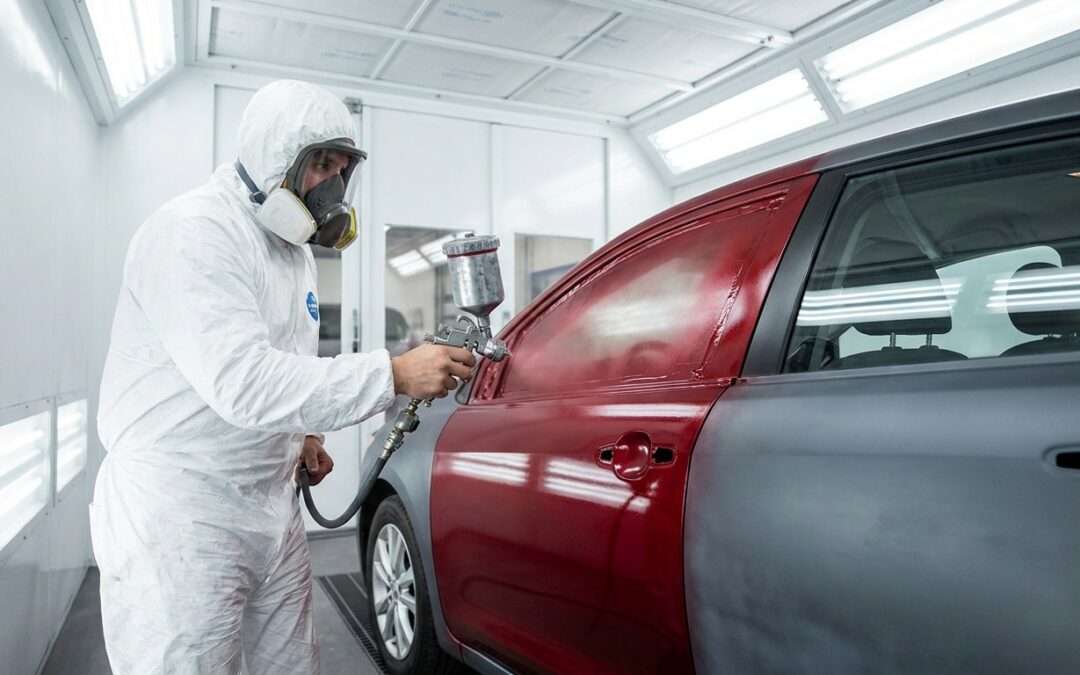
Step 6: Base Coat in a Downdraft Booth
Color goes on in 2–4 thin coats inside our climate-controlled downdraft paint booth. The booth pulls air down and through floor filters so airborne dust doesn’t land in the wet paint. Temperature and humidity are controlled to match the manufacturer’s window for that paint product. Painting in an Arizona driveway in July is how you get fish-eyes and orange peel — the paint flashes too fast.
Step 7: Clear Coat (2–3 Coats)
UV-stable clear coat in multiple coats for depth, gloss, and protection. This is what protects your color from Arizona sun and rock chips for the next decade.
Step 8: Bake / Cure
Booth heats to 140°F for 30–45 minutes to fully cross-link the clear coat. Skipping this step is a leading cause of clear coat failure in Arizona.
Step 9: Color Sand and Buff (when warranted)
For show-quality finishes we wet-sand the cured clear with 1500 → 2000 → 3000 grit and machine-polish to a glass-like finish. Removes any orange peel, dust nibs, or texture from the spray.
Step 10: Reassembly + QC
All the parts we removed go back on, gaps are checked, panel alignment is verified, and the car gets a final wash. We hand-deliver and walk through the work with you.
Faded Clear Coat? Color Change? Single Panel?
Send us photos and tell us what you’re looking for. We’ll give you an honest 2026 quote and a realistic timeline.
Why Arizona Is Brutal on Cheap Paint Jobs
Arizona has the highest UV-index average in the United States outside of Hawaii. UV is what destroys paint — it breaks down clear coat resin molecules, fades pigment, and eventually causes the clear to crack, lift, and peel. This is why “Maaco-style” cheap paint jobs that hold up fine in Ohio fall apart in 18 months in Gilbert.
What separates Arizona-grade paint from a cheap respray:
- UV-stable urethane clear coat (not enamel)
- Two-stage base/clear system, not single-stage
- Proper film build — minimum 2 mils of clear coat measured
- Climate-controlled booth with proper bake schedule
- Premium brand paint — PPG, Axalta, Sikkens, BASF; not unknown imports
- Block-sanded prep — not orbital-sanded shortcuts
Auto Paint Shop Pricing — What’s Actually Driving the Number
If two shops quote you wildly different prices for the same job, the difference is in one of these line items.
1. Color Complexity
Solid colors (white, black, silver, gray) are cheapest. Metallics cost more because they’re harder to blend without showing tiger striping. Pearls cost more again. Tri-coats (a candy color over a pearl over a base) are the most expensive because they require multiple layered passes.
2. Disassembly Level
Pulling bumpers, lights, mirrors, and trim adds 4–12 hours of labor — but produces a job with no masking lines. A shop that masks everything off can quote you cheaper, but you’ll see the result.
3. Body Work Underneath
If your panel has dents, dings, scratches, or rust, those need to be repaired before paint — and that prep work is what most cheap quotes leave out and then surprise you with mid-job. Honest shops include it upfront.
4. Prep Quality
Block-sanded with progressive grit takes 2–3x longer than orbital-sanded. The result is a finish without “wave” visible in reflections.
5. Paint Brand
PPG / Axalta / Sikkens are 30–50% more per gallon than no-name imports — but they hold color, gloss, and adhesion for years longer in Arizona UV. Always ask what brand of paint a shop is using and whether the clear coat is UV-stable urethane.
6. Booth Quality
A climate-controlled downdraft booth is a 6-figure investment. Shops that don’t have one will paint outdoors or in an open garage — you’ll see dust nibs, fly trash, and texture defects. Always ask to see the booth.
↓ Free Paint Estimate
Send 4–6 well-lit photos of the panel(s) you want painted, plus year/make/model and color (or color you want changing to). We’ll send a written estimate the same day or next morning. No obligation.
How to Pick a Real Auto Paint Shop in Gilbert
Anyone can buy a spray gun. Here are the questions that separate hobbyists from real auto paint shops.
1. “Can I see your booth?”
Real shops show you their downdraft booth, prep bay, and mixing room without hesitation. If they can’t (or won’t), keep walking.
2. “What paint brand and clear coat are you using?”
You want to hear PPG, Axalta, Sikkens, or BASF. You want to hear two-stage urethane clear, not enamel. If they don’t know what brand — that’s your answer.
3. “Do you color match with a spectrophotometer?”
The right answer is yes. Eyeballing a paint code is how you end up with a door that’s 5% off the rest of the car.
4. “What’s your warranty?”
Lifetime workmanship warranty is industry standard at quality shops. Less than that means they don’t stand behind the work.
5. “Can I see before/after photos of similar work?”
Real shops have a portfolio. They’ll show you blends, color changes, and full repaints.
6. “Do you remove parts before painting?”
For anything beyond a tiny spot repair, the answer should be yes for at least the bumper and trim. Mask-everything jobs cost less but they show.
Why Choose Network Collision Repair
- 30 years of paint experience. Three generations of painters have come up through our booth.
- Climate-controlled downdraft booth on-site. No driveway paint jobs. No subbed-out paint work.
- Spectrophotometer color matching on every job — insurance repair or custom.
- PPG and Axalta paint systems. UV-stable urethane clear coat. Not enamel.
- Lifetime workmanship warranty. If it fades, peels, or fails on workmanship, we fix it.
- We do real blend-ins. Insurance jobs that look invisible. Color changes that match jamb-to-jamb.
- Family-owned, Gilbert local. Read what your neighbors say on our About page.
Common Paint Shop Jobs We See in the East Valley
Sun-Faded Clear Coat (the Arizona Special)
You’ll know it when you see it. The roof and hood look chalky, lighter, sometimes peeling in patches. The clear coat has failed from 10+ years of UV. Options: full repaint (best), or roof + hood respray only ($1,800–$3,200 if those are the only failed panels).
Insurance Repair Blend
Bumper or fender got fixed; the new paint needs to match the rest of the car perfectly. This is 80% of our paint work and the area where shop quality matters most. The wrong shop produces a visible halo — the right shop produces an invisible repair.
Full Color Change
You bought a black car and want it red. Or a white truck and want it satin gray. We disassemble doors, hood, trunk — spray jambs, edges, and inside surfaces — then reassemble. Done right, a future buyer can’t tell it was ever a different color.
Restoration / Classic Repaint
1960s and 70s muscle, classic trucks, vintage Volkswagens. We’ve painted plenty of them. These usually involve disassembly down to the shell, weeks of block sanding, and 3–5 stages of clear coat with color sand and buff at the end.
Custom Wheels and Trim
Often paired with a body paint job. Wheels powder-coated or painted, grilles murdered out, trim resprayed. We can quote it as part of a paint package.
Auto Paint Shop FAQ — Gilbert, AZ
How much does it cost to paint a car in Gilbert AZ?
2026 ranges in the East Valley: $3,500–$8,500 for a quality two-stage same-color full repaint, $5,500–$12,000 for a full color change, $700–$1,800 per panel for single-panel refinish, and $8,000–$25,000+ for show or restoration paint. Anything advertised under $1,500 for a full car is single-stage enamel that will not hold up in Arizona sun.
How long does an auto paint job take?
Spot repair: 2–3 days. Single panel: 3–5 days. Multi-panel: 5–10 days. Full same-color repaint: 2–4 weeks. Full color change: 3–5 weeks. Show / restoration: 4–12 weeks. Most of the time is prep and curing, not actual spraying.
Will a new paint job match my existing car?
If the painter uses a spectrophotometer to read your aged paint and blends into adjacent panels, yes — you won’t see a color edge. If they spray the new panel only and don’t blend, you almost always will.
What’s the difference between two-stage and single-stage paint?
Two-stage = base color + clear coat sprayed separately. The clear coat carries the gloss and the UV protection. Single-stage = pigment and gloss in one product. Two-stage holds up dramatically better in Arizona sun and is industry standard. Single-stage is mostly used on commercial trucks and budget jobs.
How long does a quality paint job last in Arizona?
A two-stage urethane paint job with proper prep, premium clear coat, and reasonable care (not parking outside in 115° sun every day, not running through automatic tunnel washes) will look great for 10–15+ years. Cheap single-stage in the same conditions: 2–5 years.
Can you paint just one panel and have it match?
Yes — with proper blending into adjacent panels and spectrophotometer color matching. Single-panel paint without blending almost always shows a color edge, especially on metallics and pearls.
Do you paint motorcycles, RVs, boats, or commercial trucks?
Yes. We paint cars, trucks, motorcycles, classic restorations, work vehicles, and have experience on RV and boat panels. Call (480) 691-2299 with your project.
Will my insurance pay for paint work?
If the paint damage is part of a covered claim (collision, hail, vandalism), yes. Faded clear coat from age and UV is generally not covered — that’s wear and tear. Read more about how insurance handles paint claims.
Do you serve Mesa, Chandler, Tempe, and Queen Creek?
Yes. Network Collision Repair is at 1021 N Gilbert Rd Unit 105, Gilbert, AZ 85234, and most of our paint customers come from across Gilbert, Mesa, Chandler, Tempe, Queen Creek, and Apache Junction.
Real Paint. Real Booth. 30 Years of It.
Whether you need one panel blended after an insurance repair or you want your old daily driver looking like new again, we’ll give you an honest 2026 quote and a realistic timeline.
Or call us directly at (480) 691-2299 · 1021 N Gilbert Rd Unit 105, Gilbert, AZ 85234
Related reading: Auto Body Shop Gilbert AZ · Paint Correction · Bumper Repair · All Services